

The Technological Knowledge Strand Explanatory Papers Updated May 2010
Technological Modelling
Key Ideas
A model is a representation of reality. In technology, functional modelling is used to represent how things might be if a technological development was to continue to determine whether and how the development should proceed. Prototyping is used to evaluate the outcome itself once it is realised. Technological modelling is critical in the process of identifying the outcome’s potential and probable impact on the world, as it moves from conceptual idea through to being fully realised and implemented in situ. It also supports exploration of a range of influences that may impact on technological outcome, its development, and its future manufacture.
Technological modelling is a key tool for technological development across all technological domains. However, the specific knowledge and skill base underpinning the implementation of technological models and the interpretation of data gained is particular to domains.
The media used, and types of procedures undertaken in technological modelling, vary depending on the stage of development, preferences, requirements, and the capability of the technologist1. The audience from which input and targeted feedback is sought will also influence the type of media and model used. For example, at the early stage of development, functional modelling may simply involve the technologist thinking through their design ideas and/or discussing these with other technologists, to test their suitability. As the development moves on, this may progress to drawings on paper or within computer programmes, to more formal written and/or diagrammatic explanations appropriate for a wider range of audiences. Three-dimensional mockups using easily manipulated material such as clay, cardboard, styrodur, and CAD software, are often used to enable design ideas to be evaluated in terms of technical feasibility and social acceptability. Progressively, the materials used become more closely aligned to the actual materials that will be used in the final outcome, with the final prototype using these exclusively.
Technological modelling can be categorised into two related types – functional modelling and prototyping. The difference in type is linked to what is being modelled, the purpose of the modelling and the stage in the development that it is taking place.
Functional modelling is often referred to by different names across different technological domains. For example, functional modelling may be referred to as test or predictive modelling in biotechnology, animatics in film making, a toile in garment making, and mockups or mocks in architecture and structural engineering. In all these cases, what is being modelled, or represented, is the yet-to-be realised technological outcome for the purpose of testing design concepts with regards to the physical and functional nature of the outcome required by the brief. Design concepts include design ideas for parts of an outcome as well as a complete conceptual design for the outcome as a whole.
Functional modelling therefore, provides a tool to support informed projections into probable future impacts; allowing for the exploration and evaluation of design concepts, from a range of perspectives, from which to make justifiable decisions regarding the technical feasibility and social acceptability of any future development. These decisions need to take into account such things as known specifications, material and technique suitability, as well as historical and socio-cultural factors. If these are not taken into account, the likelihood of unintended negative consequences resulting from a technological outcome increases.
The earlier in the development that functional modelling occurs, the stronger the focus is on 'go/no-go' decisions. If a 'go' decision is made, the result may be to revise the design concept or move on to the next stage in development of the original design concept. Functional modelling should therefore occur extensively in the early stages of technological practice, when establishing whether the design concept being developed has worth (in its widest social sense) and when 'what if?' questions need to be asked and explored. Early stages of functional modelling often employ 'guestimation', based on similar technological outcomes and developments and/or drawing from other 'known' situations or past problems/issues.
Functional modelling provides opportunity to reduce the waste of resources that can often occur if technologists rush too quickly to the realisation phase, relying on a more 'build and fix' approach to technological development. Because of this, functional modelling can be seen as a key tool for encouraging and enabling more environmentally sensitive and potentially sustainable developments. The better the functional modelling, the greater the confidence a technologist can have that the fully realised technological outcome will be fit for purpose, and will result in fewer unknown and/or undesirable impacts on the world. While it may not result in the removal of all unknown or undesirable impacts, functional modelling can work to significantly reduce these through informing decision making around risk identification and management. However, all functional models are limited due to their representational nature. That is, what is being tested is only a simulation or a part of what the actual outcome will be.
Prototyping is the modelling of the realised but yet to be implemented technological outcome. The purpose of prototyping is to evaluate the fitness for purpose of a technological outcome against the brief.
At the point of realisation, the outcome has an increased 'impact in the world', due to the fact it now exists in a functioning material form and can implemented in its intended location. However, prototyping seeks to gather further evidence to inform subsequent decisions focusing on establishing it's acceptability for implementation or the need for further development. Evaluation of its fitness for purpose is measured against the specifications established in the brief. Because the technological outcome now exists in a material form, prototyping allows for a greater level of exploration of unintended consequences/impacts on people and the physical and social environment in which it will be situated.
As with functional modelling, decisions from prototyping can result in a 'no-go' decision or in a significant change, meaning a need to revise the design concept. Decisions to halt or significantly change development at this point suggest earlier work may not have been undertaken in sufficient depth. This has implications for the technologist, as the costs (such as time, labour, materials and money) involved in developing a prototype are high, and would be unsustainable should such decisions occur regularly at this stage of the development process.
Alternatively a decision to undertake further development may be made after prototyping, resulting in less dramatic modifications, or refinement of the outcome to enhance its performance and/or suitability. Prototyping may also result in the decision to implement as is. Prototyping thereby provides the means to evaluate a technological outcome, in order that its fitness for purpose can be optimised, or to provide justification for the outcome to be fully implemented as fit for purpose.
Prototyping can also be used for the purpose of testing 'scale-up' opportunities, and can provide key information regarding decisions around ongoing or multi-unit production and marketing for commercial purposes, as appropriate.
Specific methods of prototyping are validated by different communities and this must be taken account of if the outcome's worth is to be accepted by key stakeholders and the wider community. This is not to say new methods cannot be developed. However, any new method would need to show itself to have equal or greater benefits than previously accepted practices.
Figure 1 provides a summary of functional modelling and prototyping, as types of technological modelling within technological development.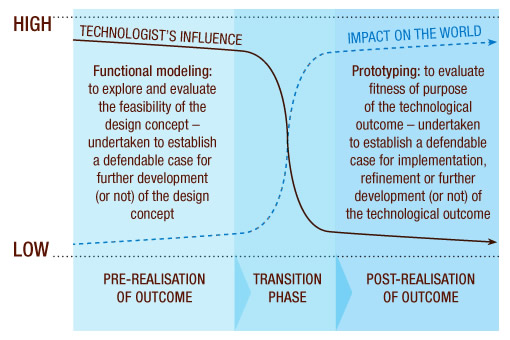
Figure 1 illustrates that a technologist's influence on the impact their work will have in the world decreases as the development work proceeds. Initially the technologist has high levels of control over how the design will progress (or not) and be developed. As the design becomes more developed and widely communicated, the influence of the technologist begins to decline. At the transition phase, where the design idea is first realised as a technological outcome in its material form, the technologist's influence declines. In contrast, the impact of the potential outcome increases as development proceeds towards its realisation, with a significant increase occurring at the transition phase.
The 'impact in the world' includes both beneficial and harmful impacts, such as environmental, social, economic, and political benefits or costs. The transition phase should be viewed as a critical decision point in any development, for once realisation of an outcome has occurred, there is 'no going back'. As a result of prototyping however, any future development work can of course be subsequently halted, or directions changed.
Technological modelling is used to inform decisions regarding risk management through identifying and assessing possible risk factors associated with the development of a technological outcome. Assessing risk involves establishing the probability of identified risks occurring and the severity of the impact should it occur. Managing risk involves making decisions to avoid, mitigate, transfer or retain the risk.
Technological modelling employs two types of reasoning – functional and practical reasoning, to ensure that a holistic evaluation of a technological outcome's potential and actual 'impact in the world' is made, reflective of a balanced normative and technical understanding of fitness for purpose. Functional reasoning provides a basis for exploring the technical feasibility of the design concept and the outcome. That is, 'how to make it happen' in the functional modelling phase, and the reasoning behind 'how it is happening' in prototyping. Practical reasoning provides a basis for exploring acceptability (related to such things as moral, ethical, social, political, economic, and environmental dimensions) surrounding the design concept and outcome testing. That is, the reasoning around decisions as to 'should it happen?' in functional modelling and 'should it be happening?' in prototyping. In this way, practical reasoning provides a framework, or rational structure, to justify what 'ought' to happen – providing the crucial 'normative' element of technology.
As discussed in CoT, contemporary technological development often involves more than one person. In the figure and discussion therefore, 'technologist' is used in an attempt to simplify the practices being described. In reality the 'technologist' may be a group of people and the make-up of this group may change as the development proceeds and different skills and knowledge are required.
