

This is Not a Love Story
Development
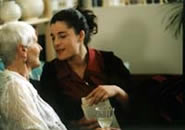
Violet (Beryl Te Wiata) and Belinda (Sarah Smuts-Kennedy)
Scene in a park
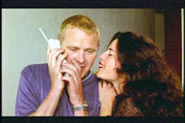

Tony (Steve Lovatt) and Belinda
COP Outcome development and evaluation Work-shopping is a common method of developing scripts for the theatre by having actors use their craft to work with a writer to develop a story and script. Keith's inspiration for his approach comes from John Cassavetes and Mike Leigh who have used actors to originate script. In this case a central character was developed as female because a female actor was interested in creating a film role. Other characters were added as the narrative grew and their roles filled out during the process. Keith, as writer, had the overall narrative picture in his control. The process was free of egos and ideas were adopted, trailled and used or dropped as the team saw fit. Evaluation was speedy and ongoing and the developing script ensured outcomes were always realistic and within the capabilities of a cast. As the cast would be headed by Sarah and Steven, and Keith would direct, the project was always seen in terms of its outcomes. As stakeholders, the actors were part of experimentation and analysis. The script's success at an international film festival showed the value of the process.
The role of the New Zealand Film Commission
“No idea is so good that it can't be improved through the contributions of others."
Keith Hill
Much of the next stage reads like the organisation for Peter Jackson's first feature, Bad Taste. With a limited budget, Keith had to live off the land. He applied to the Waikato Institute of Technology for research funding to record the process of script development. The process was an unknown method and so generated new knowledge of considerable interest to the academic study of film.
He enlisted Andy Calder of Film Syndicate to produce and add a little capital. Together they organised the shoot. Locations needed to be found, a crew assembled, film stock and other equipment purchased, and a shot list decided. Keith found a friend, Phil Burchell, to be Director of Photography and Sarah had her friend, interior designer, Cath Enchmarch, who wanted film experience as production designer. The costumes were found and made by an experienced theatre costumier, Fiona Nichols, also seeking film experience. They cut their cloth to the constraints of the project. There would be no night shoots which were expensive and required considerable lighting. The locations had white walls and large windows with a minimalist design look and Cath was able to access furnishings through her business.The crew consisted of some students who wanted experience assisting the experts. First assistant director, Hamish McFarlane, had two assistants. Director of photography, Phil, doubled as camera operator and gaffer with students as his assistants. Keith had 3 weeks (the length of his inter semester break) and settled on a shorter than industry standard working day of ten and three quarter hours. He could afford to pay only the sound crew as he knew how important quality sound was to the success of a film. Everyone else worked for the experience.
