

Delivery
Technological literacy was the focus at the start of the year. All classes learnt about the technological process, the language they would use for it, such as key factors and briefs, and that within each technological area they would use additional language to do with specific skills and knowledge. Each term saw a new common focus, such as writing a brief, and reinforcement of the generic technological language and process learnt in previous classes.
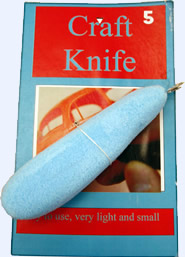
Students working in the Product Design class investigated craft knives that were available for sale and looked in detail at a variety of different knives purchased by the department. They were asked to consider the function and features of each knife, the materials used and why some material properties might be particularly suitable, and ergonomics. They also discussed whether other aspects, such as colour, might make a difference to the end purpose of the knife.
The New Zealand-designed furniture in the classroom had been used as a starting point to introduce the concept of ergonomics, and the class discussed the design, how factors such as height had to be considered, and how successful it was in terms of ergonomics. The humble potato peeler was a particularly useful item to examine, as an everyday object which is sometimes uncomfortable in use. Teachers also brought in a variety of objects with handles so that students would think about the different ergonomic needs involved and how well they were met.
In order to encourage innovation and creativity, the class was given a variety of thinking skills, so that they could look at alternative ways of creating a solution. In one exercise students looked at the features on a knife – handle, colour, blade, price, materials, safety lock and texture – and were asked to design a variation on that feature. For example, when looking at the handle students had to look at the consequences of changing it to ensure it was ergonomic, or if it were made of rubber, or metal, or in a different colour.
The students really enjoyed this exercise and came up with variations they wanted to develop in their sketching. Lesley says that this exercise was successful in encouraging students to think 'outside the square' in their designing.
In another creativity exercise, students were shown some disparate products – screwdriver, bag handle, sports object – and asked to think about how any of these ideas could be adapted to suit their craft knife.
The unit brief was that students identify a target market and design a craft knife for it. The class discussion on target market needs and subsequent brainstorming of different markets provided some hilarity, as students suggested stunt knives for actors, knives for animal skinners, and for graffiti artists who would need to secrete a knife for scratching surfaces.
After discussing the requirements both in class and at home with their parents, students wrote a brief for their own knife. This exercise was relatively straight-forward because, having investigated existing knives so thoroughly, they had a good understanding of a knife's attributes and which to use for their own particular need. They then worked on their PMIs , which encouraged more creativity as they considered how they might be able to improve their product.
The class was taught freehand sketching skills in 2D and 3D – learning oblique and isometric drawing, rendering and shading – and started sketching their own designs. Lesley comments that when students labelled their designs teachers could see that they were actually thinking beyond the sketch, making comments on alternative ideas for their knife, such as making it in different materials. "They were thinking not just of the look, but of practicalities such as a click lock. As they developed their ideas there was a lot of innovation coming through, such as the knife with see-through holes so the user could see how many blades were left. They started giving their knives names and the project became quite personal."
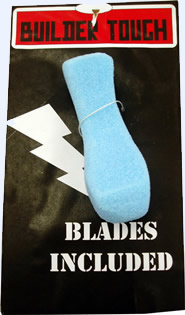
After sketching their designs the students moved on to making prototypes out of card. Using their orthographic drawing helped them think of all three elevations which Lesley says was a revelation to some. They had to think about how to draw their knife before making their prototype.
While constructing their prototypes students had to consider how to use a piece of the relatively expensive Styrofoam in an economical way, this nicely bringing in the concept of sustainability.
The first classes made the blades out of card covered in foil, but the department has since discovered a very thin sheet of metal which was donated to them.
As they worked on their knives, students had to consider its many different aspects, such as how the user would hold it to perform the required task. They would come into the workshop with their friends to test their knife, asking them how it felt and where the pressure on the knife was, and reshaping a little more after receiving their feedback. Teachers had explained the process of questioning, whether for verbal or written responses, and how to ask pertinent questions and ensure the person knew the target market of the knife.
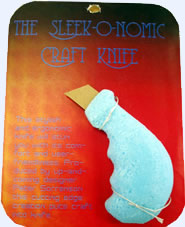
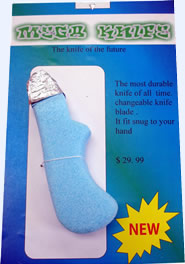
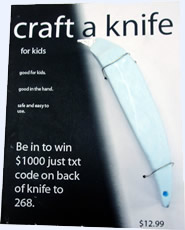
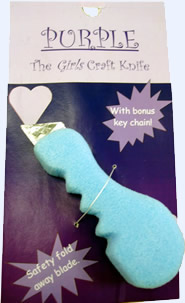
After completing the product, the class moved on to marketing and how they would advertise their knife, looking at the point of sales for their packaging. This brought in the concept of sustainability again, as students had to think about alternative ways in which their product could be packaged and marketed.
At this stage, the class moved to computers and learnt Photoshop. This was presented in a simple way – basic instructions in layering, transparency, opaqueness, and the terminology the program uses – and was an activity the students really enjoyed. As they designed their packaging, students had to think about what information it should convey about the product and how it could appeal to potential buyers. Lesley says that the class came up with some exciting advertising which really impressed all the teachers.
The culmination of the unit was the presentation and evaluation of the knives. All the products were displayed on the classroom walls and students explained their individual work to their classmates. Then everyone walked around examining all the examples and attached a note to their three favourites, explaining why they had been selected. This activity led to another good class discussion on the various aspects of the unit.
