

Pre-planning

For the 2009 project, Barbara looked to the previous year and expanded the possibilities of that unit while changing the focus to areas that she felt were of the most interest to the students and that would address important academic criteria.
"This year we really worked on developing the project brief and specifications. There was quite a big focus on teaching students how to develop their brief as a springboard to the requirements at next year's NCEA level," Barbara says.
While acknowledging that the fashion show was popular, Barbara wanted to see a progression from the previous year with the skills acquired in that unit implemented in new ways. She decided students in her 2009 class would each choose their own 'good cause' and research the most appropriate way to promote it on their T-shirt.
The new brief changed the impetus of the unit, as students had to spend far more time determining the cause they wanted to support then researching that cause to find the best possible way to get their chosen message across. This meant that the 'investigation stage' would have far more prominence than the previous year.
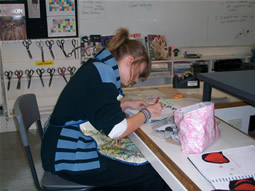
In the previous unit, Barbara had created a number of carefully structured worksheets with questions and brainstorming ideas made to create a structure of natural progression and influence the creative process. Barbara decided to update these existing templates for the new project, taking into account the different challenges that the new brief would offer the students. The success of this unit is testament to the versatility that Barbara puts into many of her unit plans, creating frameworks that can be easily adapted by her or other teachers to take on an entirely new subject.
These worksheets helped to break up a large and daunting project into manageable tasks for Year 10 students Barbara says. "It makes it more achievable, and all the little bits help the teacher with the project management so they can keep on top of things."
Barbara was keen to stress that it was "not all templating" – the worksheets functioned as a guide to the students to progress through the different stages, leaving plenty of room for student initiative, rather than them simply "filling in boxes".
"As a teacher you do create things that kids will fill in, but that's just a starting point for them to go on and do the practical stuff and their own individual work."
