

Delivery
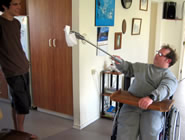
Tony and Matthew testing the tool
The first stage in the delivery of the programme was for students to choose a client and investigate and negotiate an issue.
One student chose to work with a local farmer to look at the issue of feeding calves and the design for a mobile calf feeder. In the research phase he looked at existing products, explored the environment in which calf feeders operate and the amount of feed required to be carried. He identified that calf feeders frequently end up left out in the rain, and that often little money is spent on maintenance. He decided to address the issue of durability which he identified as being a major problem with many existing products.
Another student worked with a client who was looking for a safe and convenient way to fix a tandem to the back of his four-wheel drive vehicle.
As a fall-back for students unable to negotiate a suitable issue with a client of their own choosing, Steve provided a range of options that he had identified through contact with local organisations such as the Hamilton Disability Centre. One such student was Matthew Baird for whom Steve organised a visit to the Centre. "They told me about some of the issues which they had and I thought about a few ideas for a while before settling on a client," he said. His client was Tony, who is immobile from the waist down and in a wheel chair, and for whom Matthew designed and constructed an improved version of a 'grabber' to help him pick things up – see Matthew's Student Showcase.
Once the client and the issue was confirmed for each student, Steve set up initial meetings between the students and potential industry mentors. The students were asked to create an individual profile to promote themselves and their project work and this proved to be a very effective way of achieving an appropriate match between the student and the mentor.
"I wanted the boys to have somebody other than me to sit down and talk to about their project – somebody from outside the school who would understand what they were doing and offer some added advice and guidance."
Steve joined the students in their first meeting with the mentor at which each student presented a folio of work and explained what they had been doing in their technology programme. With only six students in the class these meetings were comfortably fitted in over a three-week period early in the first term.
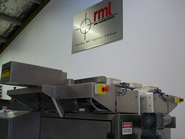
This process proved very successful and a range of mutually beneficial links, such as the The St John's College/RML Automation Link, were firmly established. Students took individual responsibility for managing the ongoing interaction with their client and with their mentor – organising the times of the visits around school, industry and personal commitments – enabling Steve time to step back and monitor the regularity and the effectiveness of the contact.
During the early part of the programme Steve emphasised the step up required in moving from Level 2 to Level 3 and discussed with each student the implications in terms of the requirements for their personal development work.
One of the mentoring companies had regular Monday morning meetings to give production and design staff the opportunity to raise individual issues and discuss specific project related problems in a whole group environment. Steve took up this idea in his programme. "Once a week all the boys brought their folders in and gave everyone a quick rundown on where they were at and identified problems that had cropped up. Later things started to get too busy so we stopped having them, but I can see how important they are."
After the first meeting with the client and the successful negotiation of the initial brief all students tended to follow a similar development path. Key factor research led into a secondary follow-up interview enabling the brief to be further clarified and more detailed specifications established. A range of concepts were developed with the final concept selection justified in terms of a concept comparison matrix. A mock-up development and evaluation phase enabled a final design to be established and materials research and selection to be carried out. Design drawings were produced and the prototype constructed. An initial evaluation was carried out and required modifications made before the final evaluation of the product was completed and documented.
With students managing their own client and mentor interaction, projects tended to progress at widely different rates with some students getting well ahead of others in their practice. This limited the amount of whole-of-class work that Steve was able to structure into the programme.
However as the end of the year approached and the individual projects reached their conclusion, the overall success of the programme was confirmed. With the project work completed, Steve invited the mentors from industry and the contacts at WECA into the school for a celebratory afternoon tea. Each student presented the outcome they had developed and talked about the value of their link with the industry mentor.
"It was a really valuable feedback session and provided closure for me for that year. It gave the students an opportunity to show how much they had gained from the out-of-school interaction and a chance to say 'Thank you very much'."
At that meeting Steve expressed his concern with the amount of time which the contact necessitated from the industry side but was surprised and delighted to find that this wasn't seen by the group to be a significant issue and that they were only to pleased to continue the partnership.
