Unit Planning in Technology: Personalised Pens
Lesson Sequence
Lesson 1
|
Lesson Sequence |
Resources |
Learning Intentions |
Introduction into Course
|
|
|
| Codes of Practice Safety in the Environment of Practice
|
Students:
|
|
Introduce Technology Cycle
|
Student module booklet
|
Students can:
|
Technological Knowledge
|
||
Skills Development
The teacher demonstrates use of tools, ie use of rulers, measuring, metric system and how to measure a rectangle 65mmx35mm onto a piece of card. |
Student Booklet Card |
|
Lesson 2
|
Lesson Sequence |
Resources |
Learning Intentions |
| Students go to assigned benches and the roll is called. The teacher then recaps on the last lesson. Then introduces the hand tools and machine tools that are appropriate to cut out the shape. The coping saw and scroll saw, the teacher then demonstrates the use of both tools as a method of cutting out the shapes keeping to the waste side of the line. Codes of practice, ie safety in practice with the use of tools and machines. Correct working procedures to gain desired outcome. Once the shape is cut out the teacher demonstrate how to file down to the line using a range of files
|
Students:
|
|
| Demonstrate how to round the edge using the fine file. The teacher then demonstrates how to sand the edges smooth using three grades of paper progressively getting the edges smoother.
|
||
|
Refer to the Class Brief Ask the students to choose a Key stakeholder – someone to design the pen for (usually a family member). |
Student module booklet
|
Students:
|
Lessons 3 - 7
|
Lesson Sequence |
Resources |
Learning Intentions |
| Technology Cycle | ||
| Introduction to issue;
Revise the technology cycle.
Introduce the issue of Pens and the use of these as promotional material and the fact that they come in all shapes and sizes. Introduce class brief and discuss attributes/specifications. |
Tech. cycle flow chart. Examples of required stationary. Year 9 teachers handbook |
Students understand the aims of the course and how graphics is an integral part of technology. Understand the stages of the technology cycle and those specific to that term. |
| Reflect on Key Stakeholder and stakeholder interests / hobbies / likes / dislikes. Complete the first page in their brief (this can be completed for homework if not done in class)
|
||
| Talk about Restrictions and the importance of Planning to make sure their pen is finished in time and to a high standard. Talk about the Key stages and the time available ( 6 sessions) What resources are needed at the different stages during the project? With teacher guidance draw this on the worksheet headed "Planning”. |
Worksheets. | Importance of planning will be understood. Students will understand what resources are needed to work through the process. |
| Concepts: Develop ideas for possible pen designs. Teach students about 2D sketches and the use of Design ideas. Use the work sheet. Draw concepts that meet stakeholder interests. Apply annotations to support ideas. (Design ideas must fit into the drawn rectangle.) |
Worksheet Drawing equipment. Colouring pencils |
Develop an understanding of the stakeholders needs. Understand and apply 2D sketching skills to visually communicate their design ideas |
| Mock Up / Model: Use mock up to test design ideas and to make modifications to the product. (scale 1:1) Use the mock ups as a template. Development: Use the model as a template to make modifications. Apply the feedback given to you by the stakeholder. Make any adjustments requested and show this on the development worksheet. Support changes / modifications with annotations. |
Drawing equipment. Card, scissors, rulers 3mm mdf Scrollsaws Worksheets. |
Learn how to cut and fold card. Learn to use scrollsaws and coping saws. Understand the importance of using a mock up as a form of testing and trialling. |
Final brief: Create a final written statement that tells you:
|
Worksheet | Understand the importance of a final brief |
| Working drawing: Teach 2D drawings - Elevations and how to apply dimensions. |
Worksheets. Formal drawing and dimensions. |
Students will understand the importance of accuracy to create a quality outcome. |
Manufacturing
|
Continuum of skills development learnt previously. |
Apply relevant knowledge and skills to manufacture an outcome |
Plastics Theory
|
|
Students can:
|
Lesson 8
|
Lesson Sequence |
Resources |
Learning Intentions |
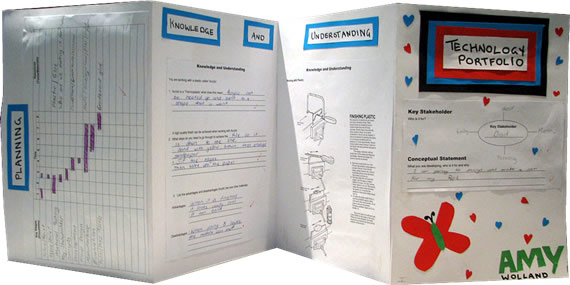
Portfolio presentation and Evaluation:
|
Evaluation sheet. Assessment Rubric Portfolio card, craft knifes and cutting mats. |
|
|
Students can:
|