

What next?
The course is work-in-progress and can always be improved upon, Jenny says. "I never do things the same way twice. I'm always thinking: 'What went right? What went wrong? How can I improve?' That's how you get progression in the quality of the course, and the quality of the outcomes of the students."
A survey at the end of the 2007 year revealed that students would have preferred to decide on what they were going to do earlier in the year, so they could learn the techniques required. "Rather than experimenting with a whole lot of techniques and then saying, 'I like this and I'll use it for that', they would rather have made the decision on what they were going to be doing, then worked out what they needed to learn, and then learn it," says Jenny.
Teaching things on a need-to-know basis can speed things up to a certain extent, Jenny says, particularly in a mixed classroom, where a range of projects are being undertaken. "It serves a number of purposes: it gets students up and rolling and into their project development earlier, rather than doing a lot of theoretical design work up-front; and it smoothes out the time-management wrinkles in the normal development process by enabling students to identify the more demanding sections of their projects and allocate their time accordingly."
It is also a way for Jenny to introduce the Modelling and Systems curriculum threads into her teaching. Jenny recognised the potential advantages of the approach after she had her Year 11 class experiment with reverse engineering. She asked her students to take an existing computer game, play it, then disassemble it. After diagramming the result, the class recognised that the game was a system made up of a series of sub-systems and inter-connected parts.
"When they developed their own program, the students first modelled their own 'game plan' diagram, then divided it into a series of components and worked on each component one at a time taking it to their clients, and getting it tested. 'Working perfectly? Done!' Then it was on to the next component. And so it meant that instead of students doing a lot of initial written work, they were starting their development earlier on."
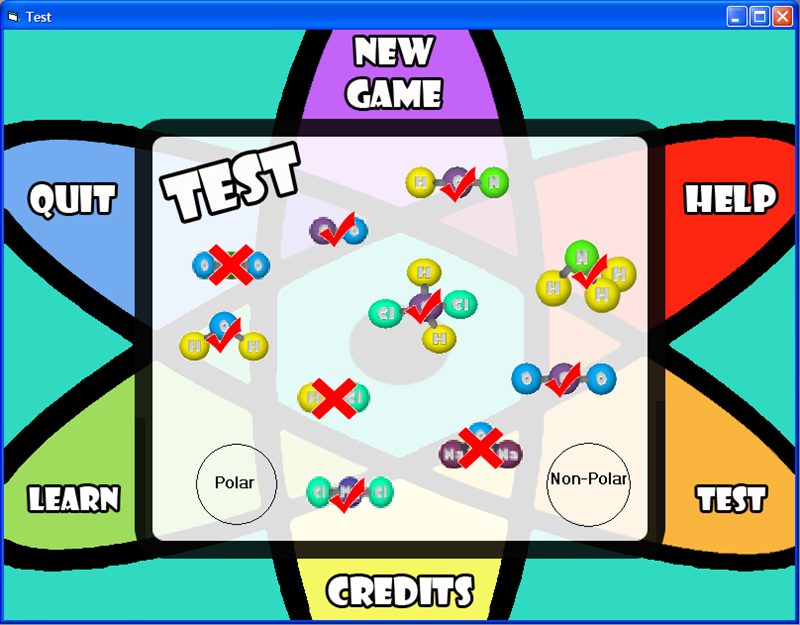
Screenshot from Katie's 'Polar atoms' game (Click image to enlarge)
In 2008, Jenny had her students use a modelling approach based on expert practice used at Jade Software in Christchurch. Jenny explained to the class how developers at Jade working on a large project for British, Welsh, Scottish Railways had met with the project's major stakeholders, brainstormed ideas with them, and then modelled these initial results. These models were gradually refined and a programme of development agreed upon. The whole project was broken up into a collection of subsections – each subsection was developed, tested, refined using client feedback and tested again, before the developers moved onto the next subsection.
"The students saw the tech practice the experts had used in an enormous British project and then used the same approach in their modelling dividing their projects into a series of subsystems, which were worked on one at a time. They planned in teams – something they had also requested in the 2007 end-of-year survey."
The teams brainstormed all the things they needed to do for their project, wrote them on post-it-notes and stuck these to a large sheet of paper. They put these notes into sequence and then divided the entire collection into subsections.
The process had to be managed to ensure team members didn't coat-tail on the work of others, Jenny says. "Because they were working in teams, I was worried that some people would do all the work and others would get credits for doing nothing." To avoid this, she had each student create their own colour-coded schematic of the proposed project (using Inspiration software).
The students are currently (August 2008) in the process of working through their diagrams, using client/teacher client feedback for each step.
This approach is slightly at odds with the conventional one, which involves completing a conceptual design for an entire project before moving onto development work; but, Jenny says, the expert approach used by the Jade developers makes sense and it works.
"If something follows external expert practice, isn't that what we [teachers] are meant to be doing?"
The modelling approach, she says, also satisfies the requirement, outlined in the external Level 2 standards, for students to look at outside technological practice, identify appropriate approaches and use them in their own practice, and justify their choices. The approach neatly embraces the new Technological Knowledge thread of the curriculum in that it deals with products and systems.
In the 2007 unit Jenny had asked her students to develop an interactive multimedia CD-ROM to inform their peers about a real-life issue of their choice. Many, but not all, students chose to work for one of their teachers, creating a solution to illustrate a particularly difficult aspect of the curriculum in an imaginative and interactive way.
In 2008, Jenny required all her Year 12 students to use teachers as clients. She suggested they find a teacher that they got on well with and who would be prepared to give them feedback. Together they were to chose a topic within a subject that the student enjoyed and that the teacher felt was difficult to get across with the resources available. The aim of their project work is to develop a graphical interactive tool to help their client teach that particular aspect of the curriculum.
Jenny is now implementing the Alternative Assessment Schedules at all three levels. "Some IT teachers feel that there's either the Computing Unit Standards, or there's Technology Achievement Standards. We integrate both, whatever is appropriate at the time for the students you're working with."
"In surveying my students, I found that they didn't want masses of credits – they were only able to use a certain number. They would rather put all their effort into getting the top grades."
Another benefit of using the Assessment Schedules is that it can reduce the amount of paperwork students have to do: "I'm trying to make the gathering of the evidence less onerous so the students have time to concentrate on what they are making. They are still thinking and doing everything that the curriculum demands – it's just that they aren't writing everything down."
