

Delivery
Student:
"My topic was based on Advanced PE. That's a subject I find incredibly enjoyable and it's something that I'm passionate about anyway, so being able to tie in ICT, which I love, with Advanced PE drove me a bit further. How passionate should students be about their issue? To a point where they could sit down a couple of hours a day and write code for it – that passion would push them through to a higher level of achievement."
At the beginning of the year, Jenny asked her Year 12 students to choose an issue they were passionate about – something they were studying in which they were really interested – resulting in a wide range of fascinating projects. Many students chose to work for one of their teachers, creating a solution to illustrate a particularly difficult aspect of the curriculum in an imaginative and interactive way, including 'Functional Anatomy' for the school's Advanced Physical Education Department, 'Polar Molecules' for the Chemistry Department. Others chose an external need and/or client, such as 'Learning the Road Code', and a 'Learning to Fly' CD-ROM for the Waikato Aero Club.
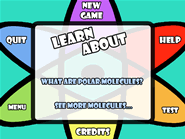
A screen-shot from Katie's Polar Molecules CD
"One student made his project about the war in Iraq. Another did his on risks in the outdoors. Another student created a program to help her father inform bee keepers about the varroa mite – although she wasn't working specifically for her peers, she was still creating a program where the bee keepers would probably have a similar expectation to the standard expected of a 16 year-old student."
During the first term, Jenny's students experimented with different multimedia programs, including animation, video capture and editing, sound recording and editing. After this, the students chose the software and programming language they wanted to use for their project.
Technological practice and project development was structured around 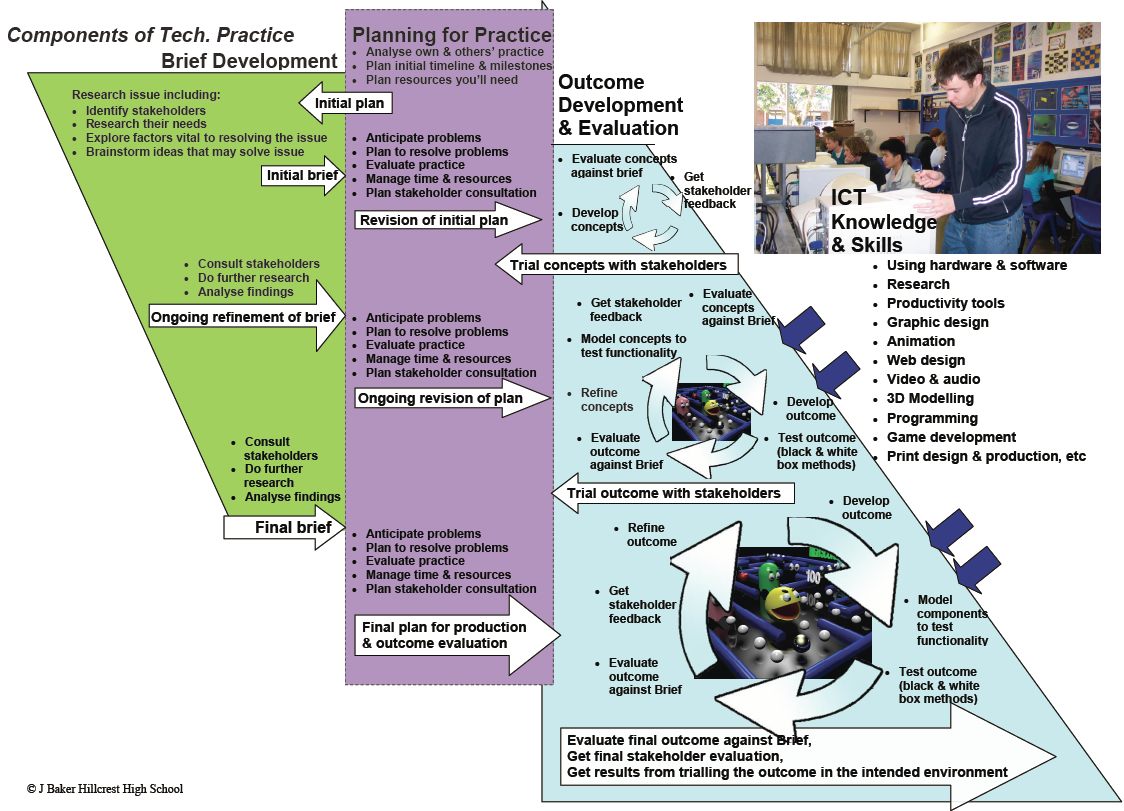
'The Diagram'>, a resource that Jenny had developed in 2005, and has progressively refined since. This diagram has proved an extremely useful resource, and is being used by other teachers at Hillcrest and other schools in the region.
Jenny's focus was very much on her students producing quality outcomes rather than ticking off assessment criteria. In 2006 she had used Level 2 external standards for the first time, which gave her a feel for what was required by the assessors. A number of her students met the standard for an Excellent that year, and this gave her the platform to extend her students further in 2007.
Resources covering programming and interface design were placed on the school's intranet, along with video case studies of expert ICT practice. "In Year 12 the external standard requires students to study ICT expert practice and use this to inform their own practice. I initially showed them relevant videos of expert practice, and they learn to search for expert knowledge to help them solve problems and extend the professionalism of their solution."
In delivery of the Year 12 course, Jenny worked with students individually, encouraging them to use their technological practice in an intuitive way. Part of the aim was to affect a low-key switch of emphasis from performing for assessment to meeting the needs and expectations of a client. "I try to get my students to think about what it is they are making, who they are making it for, what they need to do to make it better for that person, and who they can go to for expert knowledge. The evidence for assessment just falls out naturally during their practice through the year."
