

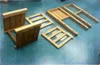




House alarm
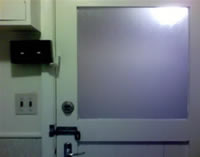
Niko's door alarm installed on the door
Niko Uusitalo
Mt Roskill Grammar School
Year 11 Electronics
Teacher: Jasveer Singh
Concern about home security prompted Niko to design a door alarm for his client (his father), whose house had been burgled several times. He discussed the problem with him and possible solutions to overcome it within a $25 budget. As entry had always been through the front door, the alarm would be situated there.
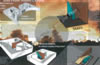
Niko researched existing products and developed four concept designs for the casing, which he modelled using computer-aided design (CAD). He selected his final design because it was compact, hard for an intruder to access, and unable to be disarmed or destroyed before the door opened.
Niko decided to make the alarm casing in plastic because it is hard, strong and easy to use. However, he eventually purchased a pre-fabricated one which was larger than he'd initially planned but saved a lot in construction time. He chose an LED because it is small, uses little power and can produce a large amount of light to show an alarm is activated and as an alert. Because the house is close to a busy road, Niko used a loud-speaker so that the alarm siren could be heard above the noise of the traffic. The alarm is powered by a battery.
Niko worked in BASIC when he programmed the Picaxe micro-controller 08N during development of the alarm, and used the EAGLE program for making his schematic. When constructing his prototype, he turned to a less technologically-advanced product – a breadboard! This proved a useful surface on which to put all the components together, allowing him to check everything was working and, because no soldering was required, to quickly remove any piece if required.
Niko mounted the components on a printed circuit board (PCB), having compared it with the prototype before soldering all the pieces. He found that the LED display didn't work when he tested the alarm and spent a lot of time checking every component before finally finding that it was a faulty micro-controller.
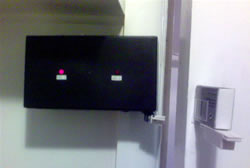
When the door is opened, the alarm
is activated
A reed switch, chosen for ease of use, was installed on the door and frame. When the switch connection is broken, the LED display lights up and flashes while the siren sounds through the speaker. Positioned low, so that it is harder to see, the alarm is turned off with a slide switch (Niko had planned to use a key switch for this but couldn't get one when he was building his final outcome, but would use one in any future alarm he builds).
Niko is pleased with his alarm and says that as the program was easy to write he had fun experimenting with different programs during the prototyping stage. His client is satisfied with the alarm and confident that it will put a stop to burglaries.
Teacher comment
Safety and quality outcome has been an extremely important key factor in the development of Nikos' project and this has been well reflected in his final outcome. Niko has been extremely thorough with his research, problem solving, testing and trialling, and especially with functional modelling skills using Google SketchUp . This technological outcome is suitable for its intended purpose.
