Reference: Case Study CP819 Classroom Practice: Year 12/13 Title: A Focus on Modelling Overview: In this case study we examine the practice of the Year 12 class of 2007, with a particular focus on modelling as a key function in the decision-making processes, from concept through to final outcome. We then follow a student through to Year 13 and look at his modelling practice. Focus Points: The case study highlights issues relating to:
Modelling
Developing design ideas
Background
Wellington College is a decile 10 boys' school with a roll of 1,500 students.
Technology is compulsory in Years 9-10, with Technology and Graphics offered as an option in Years 10-11. Technology and/or Graphics can be taken as separate subjects in Years 12-13.
After working as a freelance artist, Matthew Lane taught Graphics at four schools in the UK, three of them as HoD, and also worked as an advanced skills teacher in the subject. He emigrated to New Zealand with his wife and six children in 2002, and taught at Wellington College, where he became Head of Department Graphics and Technology (with a Technology emphasis on resistant materials) in 2005.
In that first year, Matthew's Year 12 class pioneered client-based technology at the school, and the use of university students working in-class as mentors. This class was profiled at Year 13 level in the case study BP623 Size is No Object and in the Student Showcases of Edward, Joseph and James.
In this case study we examine the practice of the Year 12 class of 2007, with a particular focus on modelling as a key function in the decision-making processes, from concept through to final outcome, then follow a student through to Year 13 and look at his modelling practice.
The Year 12 Class
The students in Matthew's Year 12 Technology class of 2007 had a range of different backgrounds and been taught by different teachers in Year 11, so it was important to establish a sound basis for the year's work right from its beginning.
Matthew therefore decided to begin with a smaller client-based project that gave students the appropriate background and experience and to develop a much bigger project, possibly, and in some cases preferably, with the same client, over the remainder of the year.
The more controlled intimate setting helped Matthew ensure that every student had the same understandings of Matthew's approach to teaching and expectations and a clear pathways they could use to creatively develop their ideas, including embedding the use of modelling throughout their technological practice.
For this first project, students were asked to develop merchandise for a café, bar and/or restaurant. They were to work with authentic clients on an identified need within the public environment of the establishment., If possible a client was to be found by the student close to where lived so they had easy access to them. "We developed letters of introduction and most students found their own clients, says Matthew. "Some needed further support, and for the two or three that didn't find a client, we used Caffe L'affare as a base. The class investigated this as an environment and the manager was very, very happy for them to work with them, and for students to explore a range of much broader issues, as there are a massive range of products and design incorporated in the enclosure." (An iconic and busy Wellington café, Caffe L'affare also roasts and supplies coffee and coffee-related merchandise witihn the café setting.)
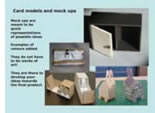
Students came up with a range of different projects including display notices, menu-holders to containers to hold beer mats and key ring holders. These small-scale objects were ideal for introducing the concepts and techniques of what Matthew calls mock-up modelling, were quick representations of possible ideas exploring different designs, forms, materials and techniques using rapid-fire modelling techniques and easy-to-use materials – see Modelling as a creative process.
Early in the year Matthew brought in a Massey lecturer to talk to the class about lighting design. "This was great," says Matthew. "We invited him to come in early, so we could set-up and discuss what he was going to talk about, how he was going to present his ideas and challenge the students' thinking. That was really beneficial. He talked about the design process – what he considered the attributes to successful lighting design, knowing that we had three or four students who were interested in lighting for their bigger projects. Students got a good appreciation of the overall awareness of problem solving and how designers go about creating different products"
Matthew also had Victoria University student mentors from the School of Architecture working with the class throughout the year. On their first visit early in the year Matthew encouraged them to do a presentation on their work. It happened that they were working on constructing display units, albums, portfolios of work to show to their clients. "As the class was looking at display units for restaurants and bars, this meshed really, really well."
At the end of term the students then moved into a larger project – either developing their initial project with the client they'd already established or moving into their own particular area. A range of projects ensued, including a 'lazy susan', a wind-break panel for a cafe, a set of plant stands, a home entertainment unit, a coaster rack and branded coasters, a medieval sword, and a coffee table profiled as a Student Showcase, and outlined in the accompanying student workbook.
Many of the students' designs were worked up in collaboration with the mentors, who helped students sift through ideas and provoked them to explore them further.
As an option, students could further develop their outcomes by exploring the requirements of the mass production of their final outcomes.
Most of the Year 12s continued with Technology the following year. "We lost five or six to apprenticeships, a couple went on to work-related employment, and the rest signed up for Year 13. This gave Matthew a Year 13 group of students who had a sound understanding of industry approaches to technological problems, and experience of a range of approaches and strategies with which to solve them.
Clockwise from top: a 'lazy susan'; a wind-break panel for a cafe; a home entertainment unit; a set of plant stands; and a coaster rack and branded coasters.
For Matthew modelling is a central pillar of the design and development process, and can be, and most often should be, used at every stage of a product's development, from concept to completion. Modelling is a form of practical evaluative process, used to explore and gauge not only form, function and aesthetics, but also appropriate materials and construction techniques, and finishing techniques and materials.
"Early in Year 12 we explore a variety of materials, their properties and how they work and how the material might be used in an eventual project, but also how the material might be used in a model to explore an alternative design."
"Some of the graphic experimentation the students undertook was designed specifically to try out an idea, to visualize it in 3D and explore alternative solutions. Some students were fairly refined in their approach to this – exploring what it would look like, and how attractive and appealing it would be."
Matthew also ensures students are steeped in the decision-making processes that go on behind all designed objects by examining products and asking the 'Why?' questions, particularly with regard to aesthetics and function. "We've done a number of these sort of things where we explored different concepts and designs, to get students to think about the function of a particular product, what do we think aesthetically about the ideas, what might they be used for, and just selecting images from famous designers, like Phillip Stark, and getting them to think: Well how successful is that? Has the designer totally lost the plot? etc, etc.
"Later on we move from aesthetics to different types of construction. And whether construction was being successfully utilized and where it could be improved. So we were using this information and getting the students to review it and consider alternatives."
Matthew points out that when doing such analysis, students may need a bit of nurturing to move from the abstract to the applied. "When it comes to taking that information and applying to their project, some students really struggled. Some could see it working in a different context but not necessarily within their own work."
Matthew introduces modelling into the concept phase of design by getting students to explore their drawings through mock-up models – quick, speedy alternative solutions to try out a range of alternative processes, materials and construction types. The results inform further drawing and exploration of ideas and further mock-ups.
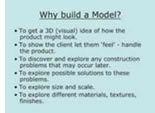
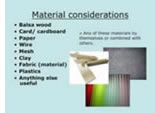
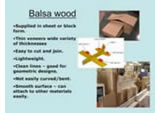
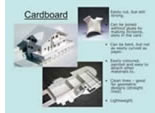
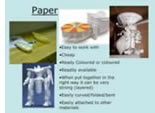
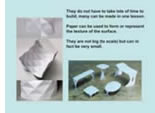
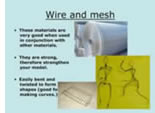
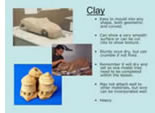
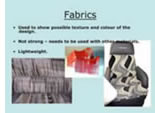
He has developed a PowerPoint presentation, Making Mock-up Models(.pdf, 885Kb), that discusses the pros and cons of different materials that could be used, including balsa wood, card/ cardboard, paper, wire and mesh, clay, fabric. This presentation explains the purpose of modelling – to:
get a 3D (visual) idea of how the product might look;
show the client let them 'feel' - handle the product;
discover and explore any construction problems that may occur later;
explore possible solutions to these problems;
explore size and scale; and
explore different materials, textures, finishes.
It also reinforces that mock-up models are part of a creative process and are:
most often small in scale;
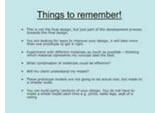
not the final design, but just part of the development process towards the final design;
a way of looking for ways to improve design, it will take more than one model to get it right;
an opportunity to experiment with different materials as much as possible – thinking which material represents a concept idea the best;
a way to discover what combination of materials could be effective; and
not necessarily complete – you can build parts/ sections of your design, e.g. joints, table legs, seat of a swing.
Functionality is an aspect of modelling that is often neglected, he says. "When modelling, often students concentrate on the aesthetics. They get the aesthetics side right – such as shape, form, style and texture – and then they blow it on the functional – such as weight, strength, construction and assembly."
"A lot of the modelling that I've seen in the schools I've visited is literally a small scaled-down replica of what students have already decided to be a their final answer. All they have done is said, 'Right, I'm going to weld this'. Why are they welding it? 'Because I want to do some welding'. No real decision has been made. Or it might be: 'I'm going to use a tenon joint here because this is something I know how to do'. Or 'I'm going to use dowel joints because I don't know anything else'. So the choice of construction, such as the kinds of joints used, is largely predetermined, either because of the student's own experience or the teacher wanting to manage the environment.
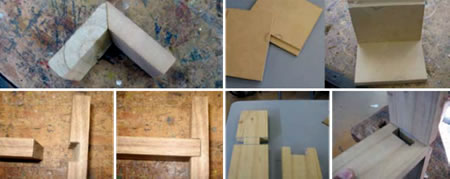
The explorative aspect of mock-up modelling is something Matthew encourages throughout a student's technological practice, particularly during construction. The modelling outlined on the Modelling in action page includes examples (some of which are not shown) of exploration through modelling – of different materials and various joints that might be appropriate in the construction – that continued through to the very end of his project.
Managing a Creative Environment
Matthew points out that managing an extensive and fluid design/modelling process is not without its issues. "If you are really going down the path of modelling to experiment with alternative processes, materials and construction type, as well as looking at the overall aesthetics, proportion, harmony and balance of the product, then you've got to anticipate constructing a large number of models using a variety of different materials and exploring different scales of models."
"Managing the environment is a key issue and needs to be debated, but it's one that we regularly have to deal with in Technology. Some of the staff actually find it quite threatening to have a lot of activities going on in one environment. It's not so easy to manage. Of course there's the health and safety aspects to consider, and also the constant question of whether the students have the capability and confidence to use the equipment that you are asking them to.
The physical workshop environment is crucial to encourage continual creative practice from students throughout a project, and for that practice to be able to be managed by the supervising staff. Since coming to Wellington College, Matthew has redesigned the workshops to ensure they incorporate areas of research (reference materials) and design (tables for study and drawing). Ideally every workshop would incorporate a computer suite for CAD drawing, which Matthew has ensured in the College's planned rebuild of the Technology block. In the interim he has set up a computer suite next door to the workshops so that students have ready access to graphic tools. This, however, poses a supervision problem for teachers, as students can be in two rooms at once and the teacher cannot leave the workshop without shutting down the machines.
To help keep on top of things in terms of knowledge and skill learning, Matthew tended to spend a lot of time structuring each week, anticipating and covering processes that students were likely to be using. "This generally meant that a new process was introduced each week, one that students had not done in the previous years. However, there are always several outcomes that are unexpected – which, of course, is a given when you are encouraging students to think outside the square – and the issues that this creates have to be managed appropriately as they arise."
Intensive modelling also means you use a lot of materials, creating cost issues. A projected average of costs was struck, balancing the minor and the major, which generally generates a fee of around $70-80 that all students pay. "Of course there are always arguments from some that their projects are costing less, but you have to strike a balance. If a student's project went significantly over this figure, and some went over $300, then they would pay the balance."
Modelling in Action
Given an open brief for a full-year year 13 project Tian Liu decided to make a bookcase for a university friend, Lin Jian, who had lots of books but very little space. Tian explored the problem from every angle and investigated existing solutions. His research led him to specialist furniture and interior design agencies that advised from commercial, aesthetic and functional perspectives. He then assimilated and moulded this information in the form of concepts and Google SketchUp
images. Finding that he needed to work with practical models to develop his ideas, he turned to modelling various possibilities, and found this an excellent way of discovering the practicalities, possibilities and limitations of his designs, and the viability of particular materials.
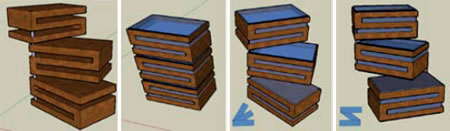
Tian began with concept drawings, focussing on aesthetics: a set of floored slatted wooden cells joined and pivoted on various common corners. "I explored different ways of rotating bookshelves. I also added acrylic to the inside of the bookshelf so light can pass through."
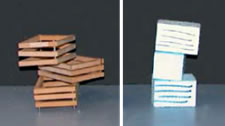
Through a series of mock-up models, in wood and polystyrene, Tian found that the pivoting action unbalanced the unit and he went on to explore other ideas. "The wooden model was made to show an idea to my client, about a rotational bookshelf. This design had a layer look to it, which goes well with books and this was very different."
While there is also the obvious question of "Where do the books go?" there are still fundamental aspects articulated in this initial abstract model that ended up as integral to Tian's final solution, despite extensive exploration of other possible solutions. These include:
the rotating three-cell structure;
the materials (wooden cells and metal pivots);
the slatted design element.
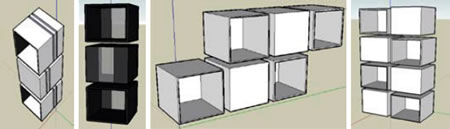
Back to the drawing board and Tian came up with some alternative concepts, continuing the exploration of cells, this time in 1950s retro styling. The unit was now static and required mounting on a wall. Consultation with the client dismissed this idea as neither desirable nor practical:
"The concepts are kind of the same," says Tian. "I have just changed by adding new styles, colours and the shapes/ order of the designs. Here I have just added new materials to the bookshelves, this fulfils the key factor of my client, which is modern."
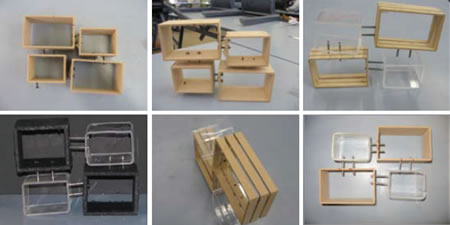
Again Tian experimented with mock-ups, both in miniature trying out different materials and colours, and full-sized, first in wood and then introducing acrylic. "These were just put together to show the design, shape and form. When it was made I kind of liked it, so then I developed it further. The first thing that came to my mind was ' How can I make this look better?' Then I thought of using different materials. Another type of material that my client would like in his bookshelf was acrylic. so using the measurements for the smaller cubes I made two out of acrylic. Using the new two acrylic cubes made a new design. When I looked at the model there was something still missing, it still wasn't perfect. Then by cutting the two bigger cubes, which gave it a later look, made it complete."
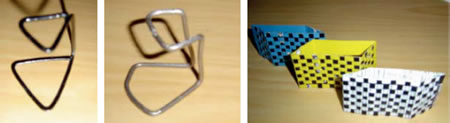
Tian also explored a number of options through mock-up modelling:
Left: "These models were made to explore the shape and form of the legs, if the bookshelf was going to be free standing. Coats of spray paint were also tested for the finish on the final product."
Right: "By weaving the materials together, I was creating a new style, this was to test the outside form and look of the bookshelf."
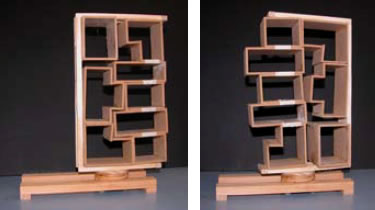
A further, highly radical, model based on an example Tian had seen on the internet, explored different possibilities of rotation and balance, and also introduces the idea of storing books on both sides of the cells. The shelves are constructed in two interlocking vertical units. One unit is on a sliding base enabling it to be rotated and repositioned. While Tian was excited by this idea, and keen to develop it further, it presented too many technical issues for him to be confident of finishing the project within time and budget.
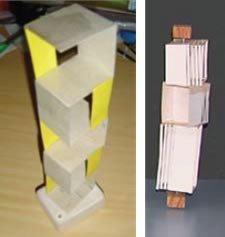
Left: Tian also explored variations of vertical stacking, combining metal (the yellow strips) and wood. This model anticipates the structural problems associated with this design. "I took the rotational bookshelf up the next stage, I came up with a new design. This bookshelf will be free standing and it will be able to rotate when locating for a book.
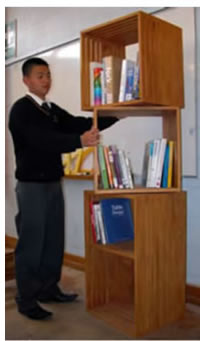
Right: Tian finally revisited his original concept – the rotating slatted cuboid three-cell structure – and included the double-sided shelving idea evolved from the modelling process. The rotation-imbalance issue was fully addressed through pivoting the cells around a central column. This last model formed the basis of Tian's final solution.
Before constructing his final solution Tian modelled some joints to decide on the most suitable:
Tian's final model still gave rise to two issues that were addressed in the final construction:
the stability of the unit as a whole; and
the fact that the central column limited storage possibilities inside each cell.
Tian believed that both issues may be solved by changing the mechanism of joining/rotating the cells. He consulted extensively with several specialist engineering suppliers including Schrodoco, borrowing and trialling devices until he came across the perfect solution – a ball-bearing race sandwiched between two circular plates that fitted between each pair of cuboids. As each rotating device was independent, it enabled the bottom unit to sit on the floor, removing the stability issue altogether.
Fixing the ball-bearing races proved problematic. Gluing and screwing would give the strongest bond, but while the plates could easily be screwed on to one cell, the second cell had to be fully in place before the screws could be inserted – an impossibility. Impossible, that is, if the units were solid, and here Tian's slotted design showed its value as it turned out that the screws could be inserted into the plate and into the lower unit through those slots.
Final outcome
Tian completed his project with excellent workmanship and finishing. He explored and trialled joints, and considered and tested a variety of stains, but decided, along with his client, he preferred a natural look. He was concerned that the joints felt a little 'loose' when the bookcase was empty, but was relieved to find that the weight of the books themselves greatly enhanced the solidity and firmness of the joints and the unit.
"Tian's maturity and quiet confidence in his problem-solving capability has won through," says teacher Matthew Lane. "He has particularly impressed with his multiple experiments and trials. Many of which were analysed and tested. His client followed the development of his problem solving with great interest and regularly requested updates.
"Some of Tian's earlier models proved to be highly favoured by Lin but later developments won though. The practical construction was very time consuming and because of the extensive modelling tests was in danger of failure but he worked all hours to complete the project to a very high standard.
"His work has featured in the staff room and will take a prominent place in the college's collegian. A great many staff have requested commissioning replicas! His design is both robust and innovative. Tian remains a hard working thoughtful and meticulous student who perfects a design solution rather than opting for mediocrity. I cannot recommend him highly enough as he has built upon an outstanding Year 12 solution with an equally original and impressive piece in Year 13."
 The students in Matthew's Year 12 Technology class of 2007 had a range of different backgrounds and been taught by different teachers in Year 11, so it was important to establish a sound basis for the year's work right from its beginning.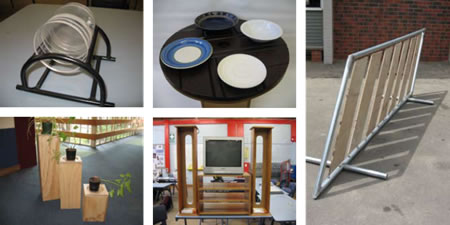
 developments won though. The practical construction was very time consuming and because of the extensive modelling tests was in danger of failure but he worked all hours to complete the project to a very high standard.