

Jo
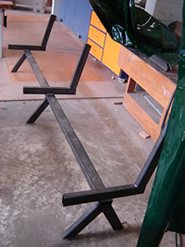
Jo considered using family or friends as clients before deciding on the College itself. He considered problem areas such as seating, the canteen and the car park and discussed them with his client, Deputy Principal Dave Ashby. They decided that the school's outside seating was a very real problem needing to be addressed and Jo took on the design construction of new seating near the Design Technology block as his project.
The key factors in Dave's brief were that the seating be strong, vandal and weather proof, safe, comfortable, long lasting and aesthetically pleasing. The main problem identified by the client was safety, both in terms of students' well-being and of the school's reputation. Cost was discussed and Jo was instructed to keep the cost to a minimum.
Jo identified a range of problems with the existing seats, some of which needed maintenance while a few were broken and beyond repair. There were numerous safety issues with their design. Students tended to play around with the existing seating, climbing and balancing on it as well as sitting! His design had to be robust enough to withstand the horseplay, such as a large number of students piled on to one end of the seat!
The aesthetics and functionality of the current seating meant it was not very welcoming or inviting for people to sit on. Many had slats missing - one had none at all - and students would stick rubbish between them, which not only looked ugly but retained moisture and could smell.
Jo's client was also concerned about vandalism - the destruction of seating or, more likely, graffiti in the form of writing, tagging or scraping. In a boys' school, where there is a lot of rough and tumble, he wanted seating that was strong enough to withstand this and that would be, as far as it was possible, graffiti proof.
Jo started off researching ergonomics. He considered body sizes, weight and height plus movements. With this knowledge he then looked at the weak points of seats. Although designing outside seating he also considered the same factors on inside seating, to further his ideas of what was comfortable, sturdy and safe.
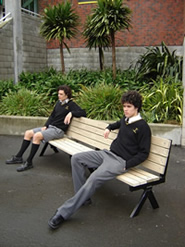
Jo next researched different materials and their qualities, as the selection of material would have a huge impact on cost. The original seating around the Science, Maths and Technology blocks was just a block of wood on bricks. He explored the idea of freestanding aluminium benches with welded aluminium legs and made numerous drawings, but these were ruled out as too costly.Several virtual models were constructed to explore the shape and form of potential solutions using the 3D modelling software ProDESKTOP. These could be rendered in a wide variety of different materials and proved to be very helpful in discussing potential ideas with the client. Throughout this process Jo kept a record of changes made and why.
"The modelling stage helps the client to fully visualise your idea," he says. "The challenge is to choose what media to present your models in that will best reflect your thinking. In my experience no one model is able to do this." When he finished making the models he applied various colours and finishes to the designs.
His final prototype could comfortably seat six students. It was robust to the point of exhaustion, having been tested by the Year 13 students jumping up and down on it.
The main frame was dip-coated black at Fraser Brown of Stratmore Ltd in Lower Hutt, then the slatted wood back attached at school. This was to be coloured yellow (Wellington College colours) but the natural tanalised finish was judged as more appealing and requiring less maintenance.
Jo found the benefit of working with a client was having a real life experience where he had to fulfil a solution to a problem. It was good to get feedback on what was liked about a design and gain experience to deal with the disappointment when something was rejected. He comments "communication is so important. A major drawback was that my client was always busy dealing with student issues, and made regular consultation a difficult process." To compensate, Jo received additional feedback from Assistant Principal John Mills.
Although the project was very time-consuming, Jo says he is happy with the outcome. He has enjoyed Technology since Year 7 and comments that, although students have been really pushed in Year 12-13, he has enjoyed the practical aspect, the creativity and developing process, particularly the environment of working with clients. "I love the interaction with people," he syas.
Jo plans to study at Media Design School, Auckland.
Read an article about Jo from the Dominion Post, June 8 2007
