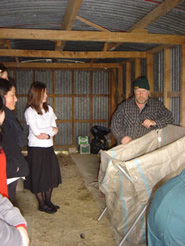
One of the Basically Bush trappers, Ricky, describes his life in the bush
The Gisborne Girls' High School/Basically Bush Link
One of the Basically Bush trappers, Ricky, describes his life in the bush
Wendy Webb of Gisborne Girls' High School has been working with Sue Boot of Basically Bush every year since 2005 on Wendy's Year 12 'Kiwi Made' unit.
Basically Bush is a possum fur-buying company based in the region. It is a major supplier to Woolyarns, a Wellington-based fibre manufacturer of Merino/possum fur mixes.
Wendy is an enthusiast of using industry links in her teaching, to extend the range of knowlededge, experience and skills available to her class, and to herself, and so her students can learn in class what goes on in business, and its importance to the New Zealand economy.
When Wendy heard of Basically Bush and their work, she saw the opportunity for the class to consider the possum fur fibre process – from collection of raw material to finished product. The collection of possum fur to combine with wool to produce an enhanced fibre for clothing manufacture was a new concept for many of the girls.
When Wendy approached Basically Bush co-director Sue Boot about working with her class, Sue saw it as a good chance to help out. She already had an affiliation with the school, her daughters having attended it, and also saw that not only was it good for Basically Bush to be seen as community-minded, but the link was a way to make the girls, and the wider community, aware of a local industry and what it does – "the more people who know about it, the better”.
Wendy supported this motivation: "I think the link should be two-way. I told Sue we'd like to help her if we can and that I'm keen to promote her product”.
Sue invited Wendy to attend a Basically Bush workshop for possum hunters. This was followed up with a class visit to observe the fur-buying process. The Gisborne area is mainly rural and the possum industry quite significant, with a lot of trappers involved in what is for many a highly professional, full-time job. Students were able to talk to the hunters about their work, observe what qualities the company looked for in possum fur and how this related to pay rates.
The Process
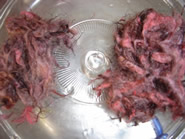
Dyed possum fur
Wendy invited Sue to talk to the students at school and found this most successful, particularly in having a proficient business woman as a role model. Sue wanted to get across to the girls that it's a good industry to work in, that it's okay to go into business and that a woman can be successful in it. She discussed her ambitions for the business – "I wanted to be the best fur collector on the market” – and the success it has had.
The girls were interested in how Sue coped in a male-dominated industry. Sue talked about setting standards when dealing with people in a business setting, in her case being particular about what she wants when buying fur and deducting pay if it is wet or contaminated. They observed how a professional approach extended to clothing – they first saw Sue dressed appropriately for a rugged environment and were impressed when she visited the classroom dressed in clothing made from her product.
At a later stage of the unit students were required to 'manipulate' materials to make their own piece of fabric, which they would use to make a garment. Sue had given them some possum fur which the class had used in a dyeing exercise and a few of the students incorporated the fur into their material.
Wendy is pleased with how the link has worked. "It has given the students more authentic practice and I have learnt more about the industry, such as environmental concerns. Students have lifted their practice and it has made them feel they're working in a genuine industry”.
Wendy feels that the link is sustainable, but comments that it takes time to set up and she has to be sensitive to industry work and time commitments. She was conscious of how physically isolated the Basically Bush operation was – being based in Wairata, about two hours drive from Gisborne – so didn't want to impose on them and involve them in too many trips to town.
From Sue's perspective the link worked well; she feels that, now it is established, any teacher at the school who was interested and wanted their students to have this industry involvement could use the relationship and work with Basically Bush. Sue suggested using Textile students who were also doing ICT to work on a (paid) project, to add graphics to the company website of garments made from their product. Wendy talked to ICT teacher Ron Elder who decided that he could work on a unit standard based around graphics that the girls working on the website could do.