Rob O'Keeffe Joinery
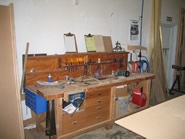
Rob O'Keeffe trained as a joiner in Upper Hutt before moving to Wanganui to work as a joiner and boat builder. Rob O'Keeffe Joiners started business in a converted horse stables at his rural family home before lack of space forced a move into a rented workshop in the city to work on the repair of a high profile local power boat. The business became incorporated in 1999 with further expansion necessitating another move to the bigger site occupied by the present factory.
The nature of the business
The company started out as a traditional solid timber company focussing on doors, windows, stairs and mouldings. However, over recent years the market has been moving more towards board work – making the likes of commercial units and office reception desks with a significant amount of new kitchen work now being sourced in the Wellington region. So the business has split into these two sections with some crossover between the areas. Two people work full time in each area with Rob himself working across both. Three out of the four workers in the factory have come through or are in apprenticeships with Rob.
"Our manufacturing work is mainly architecturally designed or designed by us for the client," says Rob. "We have to produce high quality products which are customised for a particular environment and to be used by a specific group of people."
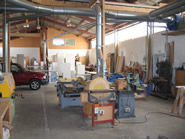
The range of machinery in the workshop is fairly traditional, with little need to invest extensively in complex computer-controlled equipment. As in all joinery workshops, care and proper use of these machines is of paramount importance. "We need people who are sensible and can operate the machines safely and maximise the capability of the machine - which includes being able to extend its useful life."
Rob will know at the start of each job whether the company will be involved in the installation – they would normally install kitchens, for example, but the builder will normally install doors, windows and staircases. With spiral staircases the joiner and builder will usually do it together. Communication between the joiner and the builder is critical to ensure that the particular fitting operates as intended. This means that the joiner needs good communication skills.
"It generally depends on how much ownership we want to take of the project. If it's a special thing, then we'll take ownership and be working side-by-side with the builder. But basically, its builders on the site and joiners in the workshop – ownership for us is in the kitchens and specialised units."
Some small work is too time consuming for the company to do cost effectively. "People come in off the street with small jobs and wonder why you just can't do it there and then and also why its going to be so expensive. While we're keen to help people with these small jobs, they've got to realise we're running a business and the jobs have to be economical."
The company has now firmly established a position in the region as a small family business with a reputation for its ability to present high quality custom built wooden products. It regularly submits entries in trade competitions and the company received two awards in the 2006 NZTIA Solid Timber Joinery Awards.
Pathways – What Rob looks for in an employee:
The joinery is a small family business, and employees have to be able to fit in with the particular requirements of the business and working environment.
"Firstly, you're not going to get in the door in a business like ours if you don't have pride in the finished product." Rob emphasises that the culture of a workshop defines the quality of the finished products.

"The ability to work as part of a team is very important. You can't go around making lots of rules for people, it just doesn't work. You can't say to somebody 'At 9 o'clock on Tuesday morning you'll grab the broom and follow that yellow line and the whole floor will be clean.' They have to be able to think for themselves and see that if something needs to be done it is done – on the spot. That's being part of a team."
"The ability to communicate is vital, especially when a lot of the time we're not working off specific plans. I need to be able to do sketches and give them to somebody and know that they can turn that into a job. Or alternatively they need to be able to tell me that they don't see that as an easy way of doing the job."
"Being well organised with good planning skills is the key to any trade. What you're really learning in your trade is how to organise a job. The more somebody is able to work independently the more marketable they are going to be."
"Also, a client is looking at your employees and judging your company by them, so being presentable is quite important nowadays. As a company we're selling ourselves all the time and we need people to be impressed by the quality of our workers. It can't always happen, people aren't perfect all the time but having that sort of a person helps a company a lot."
"It's not critical to have a good range of practical skills before working here. Sometimes it can be good to see projects that people have done, but not a necessity. You have to have good practical skills but they don't need to be proven – we can test out pretty quickly how good people are at picking up instructions and what sort of hand skills they have. Nor are we looking for experience with specific machinery. Sometimes people turning up with previous experience is not the best thing – they have preconceived ideas about how things should be done, and they're not that keen to listen to other ways of doing things."
Job profile: Spiral staircase


For this job the client asked for a curved solid timber staircase that would look elegant and sweeping. Rimu was the chosen wood because the new house was to have other rimu fittings and would be furnished with rimu items. The sketch plans supplied to Rob provided no elevations, sections or construction details and significant design input was required, making competitive pricing a challenge
"All we had was a drawing of the spiral staircase which really didn't give us enough information to build it. They had a concept of what they wanted, but we had to turn it into a reality off a pretty minimal drawing."
Coming in from the main entrance and internal garage the finished staircase leads up onto a bridge, above the entrance foyer which links the main bedrooms and living area. The stairs are a prominent feature, without being dominant as access to all areas of the house are associated with the staircase and accompanying bridge. The curve of the staircase is enhanced by the laminated, cut and mitred rimu string, laminated rimu handrail, the curved skirting in the foyer and the creation of a sill type ledge to allow the curved walls to revert to square above the stairs. Simple twisted cast iron balustrades and rimu newel post are fitted.
In the construction, a full size jig was made to form the internal string and handrail
"We had to make up a cylindrical form that was the full size of the inside diameter of the stairs and full height as well and do our laminating on that – because you can't laminate on just a circle, it has to go up on the angle as well. Its quite a complex sort of a curve."
The string was laminated with one layer of rimu then staves fitted to form the shape of the treads and risers. The staves also had the mitre for the riser on them. After the mitres were cut to the inside laminate and the treads cut, the outside rimu laminate was fitted. The outside curve of the stairs was formed with 50x50 framing timber to support the treads and riders. This all gave a relatively simple construction allowing the stairs to be made to suit the quoted price.
Rob comments that the installation was relatively painless.
"We were a bit worried about getting it into the house, but we had an idea right from the start that it wouldn't be too bad because it would wind in through the doorway like a corkscrew... which was exactly what it did!"
"Like any job you have problems you have to work through. You aim to make things perfect, but things never are perfect. The main satisfaction you get is seeing that the customers are happy with it – that's what motivates us, that's what it's all about."
Job profile: House windows


These house windows were part of a home addition of 60 square metres that included a common room, two bedrooms, an ensuite, walk-in wardrobe and a link between the house and the garage. The existing house had aluminium windows with not a lot of character. As Rob considers a timber window, properly made and maintained, better than an aluminium window he suggested in the initial plan to make the whole window out of treated pine.
The client was very particular but price was also a major consideration. Rob emphasised that a small amount of attention to detail in the finishing could produce an excellent final effect. "We were going to paint the windows but we decided to use Kwila, a versatile and reasonably priced hardwood, and varnish it. We designed a little leadlight for the windows, which turned out to be really good, sharp feature."
After hunting around, Rob found a source of reasonably cheap Kwila, which in the end was used for all of the exterior joinery, bathroom units, small areas of flooring, stairs and mouldings. All interior finishing was done with Danish oil, with an oil based paint system on the outside.
Again Rob doesn't point to any major difficulties with the project, however with some of the joinery items being angled, " stepping out of the square always provides challenges" .
Job profile: Walk-in pantry


Extensive additions and alterations to a grand old house resulted in the provision of newly created space for a new pantry attached to the existing kitchen. While a double brick wall and existing doorway provided an ideal cavity for the new sliding pantry door, the available shape – 1100 x 3000 – constrained the design.
"In the not to distant future the client planned to redo their kitchen, and they wanted something that would blend with whatever they did. The client asked that rimu be used as much as possible, including the sliding door, as this followed the theme introduced with the extensive alterations throughout the house. We decided on rimu with stainless steel tops."
Rob's apprentice, Ben Emmett, consulted with the client to design a pantry to fit the available space. It was decided to use the higher wall spaces for open shelving and a wine rack, and under-bench spaces for drawers as this would be more efficient than having cupboards. The resulting pantry included 15 drawers, three basket drawers, two shelving units and a wall mounted wine rack. The unit carcasses were constructed using 18mm white board and finished with coloured Rimu drawer fronts. The shelves and wine rack were made entirely with Rimu, while Rimu frames hold the willow baskets. Stainless steel was used for the work top.
"The main difficulty we had was in fitting as much as we could into the space available, while ensuring that that the client would be able to work comfortably in that small space. It took a bit of planning to work out how we were going to get the stainless steel top in as well. But it all worked out neatly in the end."
The result was so successful Ben won the award for Best Single Work by an Apprentice (Under 7,000 hours) in the 2006 NZTIA Solid Timber Joinery Awards.
Job profile: Whanganui Riverboat PS Waimarie restoration


Rob and his company were actively involved in the restoration of the PS Waimarie, a vessel built in London, and transported in kitset form to Wanganui. Originally named Aotea, she was operated by the Wanganui Settlers River Steamship Co until 1902, when she was sold to Alexander Hatrick and renamed Waimarie.
For almost 50 years PS Waimarie, Queen of the River, plied the Whanganui, navigating the rapids and carrying cargo, mail, riverside dwellers and tourists along this major inland highway.
She was taken out of service in 1949 and in 1952 sank at her berth in Wanganui. She remained buried in the silt and mud of the river until 1993, when she was salvaged by enthusiastic volunteers and moved into the Whanganui Riverboat Centre for restoration. On 1 January 2000 the restored Waimarie was recommissioned for her new life on the Whanganui River, as New Zealand's only authentic paddle steamer.
"During the restoration we needed somebody capable to do the interior woodwork for us," says David McDermid, from the Whanganui River Board Trust. "Vessels like the Waimarie were renowned for their attractive woodwork, so it had to be a quality job. Rob's building expertise and experience and standing made him the logical person to call on."
"This job was drip fed to us at first but we could see that it was going to grow," says Rob. "First of all we were asked to make the sashes for the windows. When the restorers realised that they couldn't make the frames themselves, we were asked to do the job and ended up making the complete windows – double hung windows on spiral spring balances rather than counterweights. Then they asked us to install them. Then they wanted us to make doors... and mouldings... and then we got on to the interior.
"In the end they did the deck and we lined the coach roof and walls inside it." Miro, totara and rewarewa were among the variety of native timbers sourced by the restoration team, much of it donated but Rob arranged to get further materials. "We used a lot of recycled timber and were able to source enough miro from up around Turangi to pretty much do the whole inside of the boat."
"Rob and his team did a magnificent job of bringing out the best in the high quality timber we had available," says David.
To ensure authenticity Rob's team worked from old photographs and the designs that restoration engineer Gil Bycroft produced. "We were able to add a bit of our own flair into things in places in discussions with him."
"Altogether we were working on the project for about six months – not all the time, but when it came to the installation stage we had to work a lot of weekends. But it certainly was an interesting and enjoyable job, because it was something that the whole community was getting behind."
Job profile: Church windows


In this small but tricky job, Rob had to replace some 100 year-old windows in St Mary's Church in Upongaro outside Wanganui. St Mary's was built in 1877 and is the oldest church in the region still at its originla site.
"The church had two curved louvre frames and a couple of window frames that had gone rotten, so we had to copy exactly what was there. However, the original frames were made quite badly out of shape and uneven on each side. So we've made them so that they look the same as the original ones, but we tweaked them a bit to be more accurate and look a bit better – you can't make something new and not right!"
Job profile: Kitchen refit


In this job remodelling a kitchen, the client was looking for a kitchen which would be comfortable to work in with plenty of easily accessible storage space. They wanted to be surrounded by the working area and away from the direct sunlight outside.
Since it was to fit in with the look of an older house, they didn't want an ultra-modern stainless steel look and wanted as much of the equipment as possible hidden from view.
"It was a big kitchen but the job presented no real difficulties apart from a fridge which needed an integrated door – one that looks like an ordinary cupboard door. Also the bench tops were to be made by a company in Carterton, so we had to order those and make patterns for them which was a little tricky, but apart from that it's a pretty standard kitchen."
The clients say they enjoy the spacious uncluttered feel when working in the finished kitchen and the way it blends in with the rest of the extension work.
Job profile: Annihilator repairs

Annihilator is a Grand Prix Hydroplane which has been competing for a few years now and is still going hard and strong. The boat has raced successfully in NZ and Australia and has held major trophies including AE Baker, Masport Cup, EC Griffiths and all available NZ National Titles at one time or another. Annihilator won the 2006 GP Hydroplane World Championship. at Lake Karapiro, New Zealand.
With the pressure of competition over the years, much of the hull has had to be rebuilt and replaced. In 2004 Rob and his team spent about two months on one particular repair job.
"The boat had been racing in the harbour at Dargaville and it either hit a wave, or something broke on the boat ... it was going about 250 km/hr at the time so the front of the boat dug into the water and things went very wrong... and a lot of damage was done." Rob O'Keeffe
"There was a lot of hours done on the job over that two month period. We had five guys working on it nearly full time, and a lot of us were doing well over 100 hours a week on it."
However the deadline was successfully met and Annihilator was back in the water racing on schedule. See a gallery of the repairs and damage.