
Poster advertising the film

Belinda from a scene in a gallery

Image from the film
This is Not a Love Story
Poster advertising the film
Belinda from a scene in a gallery
Image from the film
Loose Unit Productions
Bruce de Grut
Techlink would like to thank Keith Hill and Bruce de Grut for their contributions to this case study.
This is Not a Love Story is a Loose Unit film production by Keith Hill. Since shooting started in 1999, this film has grown through stages of evaluation and refinement to achieve an award for script at the Dances with Films Festival in Los Angeles and commendation by Variety magazine as “more adult than most American indie[films] ".Awaiting printing on 35mm film for screening in cinemas, the film has had positive responses at its many screenings via video projector, and Keith has shot new material and edited the film a number of times in response to market feedback and professional evaluation.
Loose Unit was set up to produce this film project which began as an idea for a comedy-drama inspired by Keith's own experience. As a film artist he was only too aware of the tension between the desire to be creative and paying for living expenses. So he imagined a would-be artist, a writer, and a narrative dictated by a tiny budget (Conceptual statement).
The concept was tailored to a 3-week shoot, with a low budget ($50,000), contained locations and only a few characters. Keith, as director, developed the script over 7 months in a unique working process with actors Sarah Smuts-Kennedy and Stephen Lovatt. Other actors assisted by improvising dialogue during the work-shopping of scenes Keith had devised. The work-shopping was video-taped and Keith would write the parts he liked into script which was in turn work-shopped and developed.
Development
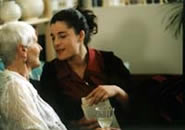
Violet (Beryl Te Wiata) and Belinda (Sarah Smuts-Kennedy)
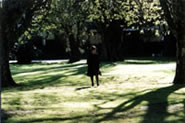
Scene in a park
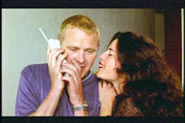
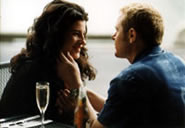
Tony (Steve Lovatt) and Belinda
COP Outcome development and evaluation
Work-shopping is a common method of developing scripts for the theatre by having actors use their craft to work with a writer to develop a story and script. Keith's inspiration for his approach comes from John Cassavetes and Mike Leigh who have used actors to originate script. In this case a central character was developed as female because a female actor was interested in creating a film role. Other characters were added as the narrative grew and their roles filled out during the process. Keith, as writer, had the overall narrative picture in his control. The process was free of egos and ideas were adopted, trailled and used or dropped as the team saw fit. Evaluation was speedy and ongoing and the developing script ensured outcomes were always realistic and within the capabilities of a cast. As the cast would be headed by Sarah and Steven, and Keith would direct, the project was always seen in terms of its outcomes. As stakeholders, the actors were part of experimentation and analysis. The script's success at an international film festival showed the value of the process.The role of the New Zealand Film Commission
“No idea is so good that it can't be improved through the contributions of others."
Keith Hill
Much of the next stage reads like the organisation for Peter Jackson's first feature, Bad Taste. With a limited budget, Keith had to live off the land. He applied to the Waikato Institute of Technology for research funding to record the process of script development. The process was an unknown method and so generated new knowledge of considerable interest to the academic study of film.
He enlisted Andy Calder of Film Syndicate to produce and add a little capital. Together they organised the shoot. Locations needed to be found, a crew assembled, film stock and other equipment purchased, and a shot list decided. Keith found a friend, Phil Burchell, to be Director of Photography and Sarah had her friend, interior designer, Cath Enchmarch, who wanted film experience as production designer. The costumes were found and made by an experienced theatre costumier, Fiona Nichols, also seeking film experience. They cut their cloth to the constraints of the project. There would be no night shoots which were expensive and required considerable lighting. The locations had white walls and large windows with a minimalist design look and Cath was able to access furnishings through her business.The crew consisted of some students who wanted experience assisting the experts. First assistant director, Hamish McFarlane, had two assistants. Director of photography, Phil, doubled as camera operator and gaffer with students as his assistants. Keith had 3 weeks (the length of his inter semester break) and settled on a shorter than industry standard working day of ten and three quarter hours. He could afford to pay only the sound crew as he knew how important quality sound was to the success of a film. Everyone else worked for the experience.
Quality Control
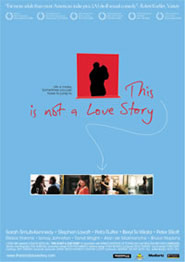
Advertising poster
COP Outcome development and evaluation
This was monitored by the experienced professionals working all day on the shoot. The experience of a shoot is very intense and open to continual scrutiny by experts who have to get it right. Everyone is watching the product develop in one place at a time. A number of takes enables several chances to improve on the work.Post Production
But the film is not complete at the end of shooting. It still needs to be edited, sound effects and music added and then printed onto 35mm stock to enable projection in the cinema. This process plus extra shooting and the creation of special effects occupied Peter Jackson's company for an entire year between the release of The Lord of the Rings films. It has taken longer for Keith because of insufficient funding. But he had a cut ready for screening by January of 2000 and a number of audiences were able to give him valuable feedback. A Film Commission questionnaire was used for test screenings and this material convinced Keith to shoot a new opening and reduce the scenes. He shot material to signal the comedy of the story which had not registered with audiences. Re-editing eliminated one character completely and greatly diminished the role of another.
The Commission was not forthcoming with funds to enable the film's blow-up to 35mm so Keith took the video of his film to film markets in Los Angeles and Cannes. He found that films there already had distributors who were looking for award winners to boost the reception of their product. Many had name actors in them too. And the films were all 35mm. Undeterred, Keith visited some art house cinemas and asked himself what it would take for audiences to want to see his movie.
Adding Value
CREDITS
Length 82 minutes
Production format Super-16mm colour negative
Producers Andy Calder, Keith Hill
Writer-director Keith Hill
Cast
Belinda Sarah Smuts-Kennedy
Tony Stephen Lovatt
Suzanne Peta Rutter
Violet Beryl Te Wiata
Karl Peter Elliott
Geoff Stelios Yiakmis
TV writer Bruce Hopkins
TV studio Tandi Wright
Bookstore attendant Ismay Johnson
Violet's friend Alan de Malmanche
Violet's niece Ismay Johnson
Key crew
1st AD Hamish McFarlane
DP/operator Phil Burchell
Production designer Cath Enchmarch
Costume designer Fiona Nichols
Location sound recordist Dave Hurley
Editor Keith Hill
Music Steve Garden
Sound designer Chris Burt
Key contributors
Suzanne's paintings Viky Garden
Original songs A.J. Bell
Festivals
DancesWithFilms. USA, July 2002. In competition. Winner: Best Screenplay
IndieVision Fest. Official selection. USA, September 2002
Milan International Film Festival. Official selection. Italy, October 2002.
Keith returned to New Zealand and shot extra scenes with the male lead to add more production value to the opening of the film. This enlarged the scope of the film in its early stages by introducing both the main characters and suggesting what might develop between them. The new opening made the film more resonant with possibilities.
Keith also secured another grant from Waikato Institute of Technology to enable work with a composer, Steve Garden, who had been adding a score over two years – and losing portions of what he had composed as scenes were eliminated in the editing. By March of 2002 the film was a finished product (apart from the blow-up to 35mm) and entered in the Dances with Films Festival in Los Angeles where it beat 1200 entries to make a shortlist of 12. It also won the script award and made Variety magazine which encouraged investors to support the cost of finishing the film.
Keith is still trying to raise the funding to enable this project to be screened. Films are often subject to re-writing and re-editing, re-shooting and test screenings. As products whose final success depends on audience interest they are not always right first time. Art films are subject to limited distribution opportunities and need to be sold through other avenues than mainstream cinema to make money. They also need to win awards to give them a selling point.
COP Outcome development and evaluation
The film-making process allows continual testing and analysis. To grow from a conceptual design a film must convince a number of key experts. To reach the operational stage requires refinement and even during operation, modification is ongoing as more experts bring their perspective. Even after shooting, further refinement and testing continues.Support for the project came from The Waikato Institute of Technology, Atlab Laboratory, Kodak, Panavision, Metrofilm and Images Post. The film was edited on Avid in the Media Arts Department of the Waikato Institute of Technology. Art works, furnishings and art-craft items came from Katalog, Zambesi, Anna Bibby Gallery, Hogland Art Glass. In addition, Viky Garden lent her distinctive and impressive paintings to the film.