CP818: Craft Knives
Abstract
Reference: Case Study CP818
Classroom Practice: Year 9 Graphics/ICT Technology
Title: Product Development: Craft knives
Duration: One term
Overview: This unit was planned as part of a revised Year 9 Technology programme for 2008. All students rotated around four domains over the year – Food, Soft Materials, Hard Materials and Product Design which incorporated Graphics and ICT Technology. In the Craft Knives unit students learnt drawing and ICT skills as they developed a Styrofoam craft knife for their target market.
Focus Points:
Background
Takapuna Grammar School, on Auckland's north shore, is a decile 10 school with a 2008 roll of about 1,633 students. The Technology department is based in a new Technology and Art Centre, which was designed so that rooms could easily be adapted for future developments – thus fitting in well with the philosophy behind Technology.
All Year 9 students take Technology as a compulsory subject and in 2008 rotated through four different domains in a new Technology programme – Food, Soft Materials, Hard Materials and Product Design which incorporated Graphics and ICT Technology. At Year 10 they choose one of these Technology options for the full year.
Lesley Pearce trained as an Art teacher in the UK and took on Technology when a new curriculum was introduced there. After arriving in New Zealand in 1994 she taught Art and Technology at Diocesan School for Girls, teaching more Technology each year and becoming HOD. In 2002 Lesley took up the HOD Technology role at Takapuna Grammar School, commissioned with reorganising the department in line with the new curriculum.
Pre-planning
Teachers in the Technology department had discussed how they could change their programmes to fit in with the Technology curriculum and the proposed changes in 2010 (when the Technological Knowledge and Nature of Technology strands would be incorporated). They decided to trial a combined Year 9 programme in 2008 in which they would teach these strands plus the existing Technological Practice.
After considering how best they could implement a Year 9 programme that would strengthen Technology throughout the school and meet the needs of the students, the community and the new curriculum, the department decided to follow the model used at Havelock North High School – see case study BP608 Programme Planning. Making a focus for each term, such as writing a brief, allowed the Takapuna teachers to research and develop resources to make these aspects relevant to the units and the students.
The year-long programme was already divided into four terms corresponding to four subject areas designed to cross-link with each other. Students took a term of Food, Soft Materials, Hard materials and an ICT/Graphics unit called Product Design, which focussed on improving student design thinking, modelling, developing graphics and ICT skills, and using technological practice to develop a product for a specific target market.
All Year 9 students were tested on their technological literacy at the beginning of the year, to give teachers an indication of what learning needed to be introduced or reinforced. Most of the students had been taught craft skills rather than Technology at intermediate, so the first term had to include an introduction to the tools of technological practice – briefs, planning, etc, for each of the four subjects.
The Product Design course, taught by Lesley Pearce, Demelza Cusens, Anthony Kwan and Steve Pearce, would be taken by 350 students altogether so cost was an important factor. Planning involved coming up with a project based on an inexpensive product that would also enable teachers to bring up a lot of technological issues during the course.
The Craft Knives project was based on a unit Lesley had taught years earlier, but was completely revised to fit in with the three new strands of the curriculum. Using a small, inexpensive item like this allowed students to easily look at existing products, their materials and features, ergonomics, and fitness for purpose.
Lesley notes that this unit is particularly good at seizing the boys' attention. "We investigated all sorts of things – you could look at bakers' knives, hunting knives, all kinds of dangerous objects, as you can imagine!"
Delivery
Technological literacy was the focus at the start of the year. All classes learnt about the technological process, the language they would use for it, such as key factors and briefs, and that within each technological area they would use additional language to do with specific skills and knowledge. Each term saw a new common focus, such as writing a brief, and reinforcement of the generic technological language and process learnt in previous classes.
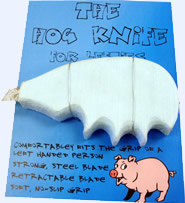
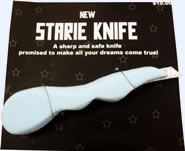
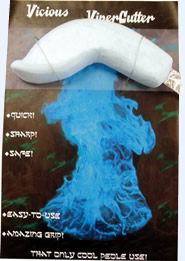
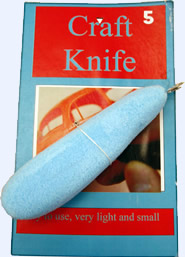
Students working in the Product Design class investigated craft knives that were available for sale and looked in detail at a variety of different knives purchased by the department. They were asked to consider the function and features of each knife, the materials used and why some material properties might be particularly suitable, and ergonomics. They also discussed whether other aspects, such as colour, might make a difference to the end purpose of the knife.
The New Zealand-designed furniture in the classroom had been used as a starting point to introduce the concept of ergonomics, and the class discussed the design, how factors such as height had to be considered, and how successful it was in terms of ergonomics. The humble potato peeler was a particularly useful item to examine, as an everyday object which is sometimes uncomfortable in use. Teachers also brought in a variety of objects with handles so that students would think about the different ergonomic needs involved and how well they were met.
In order to encourage innovation and creativity, the class was given a variety of thinking skills, so that they could look at alternative ways of creating a solution. In one exercise students looked at the features on a knife – handle, colour, blade, price, materials, safety lock and texture – and were asked to design a variation on that feature. For example, when looking at the handle students had to look at the consequences of changing it to ensure it was ergonomic, or if it were made of rubber, or metal, or in a different colour.
The students really enjoyed this exercise and came up with variations they wanted to develop in their sketching. Lesley says that this exercise was successful in encouraging students to think 'outside the square' in their designing.
In another creativity exercise, students were shown some disparate products – screwdriver, bag handle, sports object – and asked to think about how any of these ideas could be adapted to suit their craft knife.
The unit brief was that students identify a target market and design a craft knife for it. The class discussion on target market needs and subsequent brainstorming of different markets provided some hilarity, as students suggested stunt knives for actors, knives for animal skinners, and for graffiti artists who would need to secrete a knife for scratching surfaces.
After discussing the requirements both in class and at home with their parents, students wrote a brief for their own knife. This exercise was relatively straight-forward because, having investigated existing knives so thoroughly, they had a good understanding of a knife's attributes and which to use for their own particular need. They then worked on their PMIs , which encouraged more creativity as they considered how they might be able to improve their product.
The class was taught freehand sketching skills in 2D and 3D – learning oblique and isometric drawing, rendering and shading – and started sketching their own designs. Lesley comments that when students labelled their designs teachers could see that they were actually thinking beyond the sketch, making comments on alternative ideas for their knife, such as making it in different materials. "They were thinking not just of the look, but of practicalities such as a click lock. As they developed their ideas there was a lot of innovation coming through, such as the knife with see-through holes so the user could see how many blades were left. They started giving their knives names and the project became quite personal."
After sketching their designs the students moved on to making prototypes out of card. Using their orthographic drawing helped them think of all three elevations which Lesley says was a revelation to some. They had to think about how to draw their knife before making their prototype.
While constructing their prototypes students had to consider how to use a piece of the relatively expensive Styrofoam in an economical way, this nicely bringing in the concept of sustainability.
The first classes made the blades out of card covered in foil, but the department has since discovered a very thin sheet of metal which was donated to them.
As they worked on their knives, students had to consider its many different aspects, such as how the user would hold it to perform the required task. They would come into the workshop with their friends to test their knife, asking them how it felt and where the pressure on the knife was, and reshaping a little more after receiving their feedback. Teachers had explained the process of questioning, whether for verbal or written responses, and how to ask pertinent questions and ensure the person knew the target market of the knife.
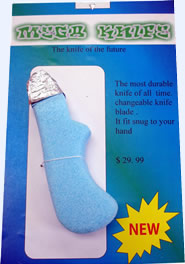
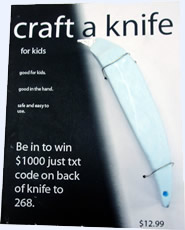
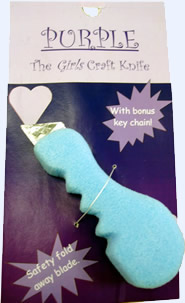
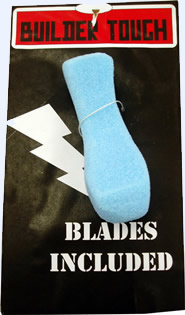
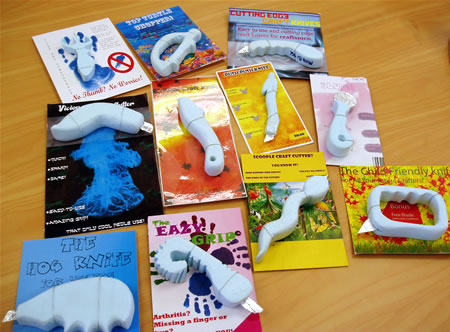
After completing the product, the class moved on to marketing and how they would advertise their knife, looking at the point of sales for their packaging. This brought in the concept of sustainability again, as students had to think about alternative ways in which their product could be packaged and marketed.
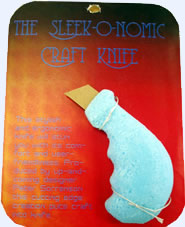
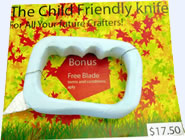
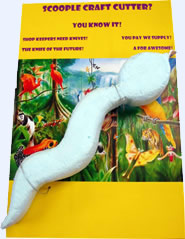
At this stage, the class moved to computers and learnt Photoshop. This was presented in a simple way – basic instructions in layering, transparency, opaqueness, and the terminology the program uses – and was an activity the students really enjoyed. As they designed their packaging, students had to think about what information it should convey about the product and how it could appeal to potential buyers. Lesley says that the class came up with some exciting advertising which really impressed all the teachers.
The culmination of the unit was the presentation and evaluation of the knives. All the products were displayed on the classroom walls and students explained their individual work to their classmates. Then everyone walked around examining all the examples and attached a note to their three favourites, explaining why they had been selected. This activity led to another good class discussion on the various aspects of the unit.
Outcomes
Every student had a tangible outcome at the end of the unit which reinforced a feeling of achievement. This served not only as something they could take home and be proud of, but an opportunity to show parents what product development is all about and how the technological process was used to develop the knife.
The Year 9 programme has confirmed for staff that teaching Technology at an early age means students don't have any problems with that way of thinking in Years 10 -13. Lesley says that because of this thorough grounding, they have great hopes for this intake of students when they get to the senior school and NCEA. "We're trying to create a very holistic Year 9 programme. Students are given a toolkit of knowledge and understanding of what Technology is, and they should be able to transfer that knowledge and those skills to whatever they do and whichever options they choose after that year".
What next?
Craft Knives was very successful, but the Design Product course will be based around a different product in 2009 so that students view it with a fresh eye, instead of looking back at the results from the previous year. Lesley points out that it's also good for teachers to have variety to ensure they don't become complacent. "I think we, as staff, should be challenged as much as the kids". However, Craft Knives might be taught again in three years or so when it will be new to incoming students.
Lesley is now working with Team Solutions, providing professional development in Technology to schools in Auckland and Northland.