
James working on his air-hockey table
BP627: Size Is No Object!
Abstract
James working on his air-hockey table
Reference: Case Study BP627
Classroom Practice: Year 13
Title: Size is no object!
Overview: Consolidating on similar work in Year 12, Wellington College Year 13 Technology students undertook a client-based project with free choice of client and negotiated project, in an environment of class-based skills tuition, individual instruction and university student mentoring.
Focus Points: The case study highlights issues relating to:
Background

Wellington College is a decile 10 boys' school with a roll of 1,500 students.
Technology is compulsory in Years 9-10, with Technology and Graphics offered as an option in Years 10-11. Technology and Graphics are offered in Years 12-13. Graphics has tended to be more popular, but this has begun to change, partly due to the Beacon Practice work being done at the school.
After working as a freelance artist, Matthew Lane taught Graphics at four schools in the UK, three of them as HoD, and also worked as an advanced skills teacher in the subject. He emigrated to New Zealand with his wife and six children in 2002, and taught at Wellington College, where he became Head of Department Graphics and Technology (with a Technology emphasis on resistant materials) in 2005.

In 2005, Matthew Lane's Year 12 class (of 20 mixed ability students) pioneered client-based technology work with Year 5-6 students at St Marks Church School. Their projects were based on problem solving relating to St Marks's specifically, with 50% of the projects ultimately being accepted and implemented. Matthew had three university students coming in to work with his class as mentors, plus several outside specialists visiting and giving input.
Pre-planning

Fifteen of the 20 2005 Year 12 Technology students returned to do Year 13. Matthew decided that the class would repeat their Year 12 unit but this time with a choice of three clients, plus the option of selecting their own.
Matthew first established the buy-in and approval of the three clients - Te Papa museum, a lighting company, and - for students who might prefer the more familiar and close-to-home client - the College itself.

In planning the unit, Matthew was aware that the 2005 project selection stage had ended up taking too much time. In giving the unit increased freedom of choice and flexibility, it was therefore very important that the time-frame for each stage of the project was clear, and that deadlines were set. Students had to be conscious of the need to complete work by key dates, and informing stakeholders of these requirements was part of the planning process.
Delivery

Most of the class chose to work with a client of their own choice (with two selecting their previous year's client St Mark's). Of the remaining students, three chose the lighting brief and three Wellington College, and none chose Te Papa.
All students quickly established regular contact with their clients and explored the further, wider stakeholders for whom they would be working. During this vital, early stage of project identification and mapping of individual targets, Matthew got appendicitis, had to take leave, and was 'knocked for a six' for a month. Despite this the students all completed this stage successfully.
The 2005 unit had included a large number of visiting specialists - to present information to students, discuss ideas and work alongside them reviewing and critiquing their work. In 2006 there was more individual contact and greater student flow in and out of the class to meet clients. This necessitated certain lessons being timetabled covering the key strategies for that week. Most were PowerPoint presentations or ICT-related deliveries, which were also placed on the school intranet, enabling students to review the set targets and their progress.
With the breadth of client contact and scope for identifying potential needs came a huge variety of projects. Resolving these required a wide range of processes and the exploration of multiple materials.
Matthew says it was quite complex to ensure that individual student needs were met. Key to this was the decision as to whether to give group demonstrations or individual tuition. Certain processes and content were relevant to all - plastic resin embedding, pattern making and forming, for example, were fairly generic areas and ones that all in the class needed to learn. Matthew gave individual guidance on other skills such as casting, welding, wood turning, laminating and milling.

A cat eating from Owen's cat feeder
In conjunction with the lighting company, Matthew had a Victoria University lecturer involved with those doing the lighting project. This gave an opportunity for students to participate in some university lectures, an experience they found quite daunting.
Victoria University Industrial Design student mentors again proved to be invaluable to the unit. The Year 13 students enjoyed the interaction and found it very positive, especially when the university students brought in their own projects and critiqued and discussed their problem-solving processes and solutions.
The delivery of the unit also included a visit to the Alcan Packaging Daniflex factory. This enabled students to experience first-hand the role of technologists in industry and their problem-solving approach, quality control and breadth of knowledge. A great deal of debate and discussion followed, demonstrating the students' growing awareness of and appreciation for the subject and its contribution to society.
As a result of their experiences in the Year 12 unit, the Year 13 students had a much better awareness of the mutual interactions between designers, technologists and society. This led to more searching questions of the specialists with whom they worked, and consequently a deeper understanding of technological issues involved and their local and national contexts.
Outcomes

The result of the year's work was production of some high quality artefacts and the students were deservedly proud of what they had achieved.
A highlight for Matthew was an animated and intense hour-long discussion on the merits of one of the student's work by four others. The arguments for and against were critical, analytical and cuttingly functional. He only regrets that he didn't have a video available. For the five students involved, technology had moved on to a different level. They were passionately involved in each others' work, contributing meaningfully to their questions and needs. They had become advocates for the subject and would be great ambassadors.
Partway through the course Matthew identified five students who were highly motivated with plenty of ideas, and who became Scholarship candidates.
Matthew was surprised at how many left their practical piece to the last minute, putting pressure on themselves, teachers and parents. However he was amazed at how hard others would work through several nights to present superbly finished prototypes.
Some pieces needed to undergo a process that could not be done in the school workshop, for example a metal seat frame that was sent to a plastic coating company. These students learnt that outsourcing of project finishing meant working to specific deadlines. Welcome to the real world!
Some of the mid range students completed their work successfully and their clients were positive about the outcome. However Matthew felt that their projects lacked the depth and breadth that the best ones exhibited. A couple of students managed to complete their project to the modelling stage but not the prototype or realised artefact.

Sports commitments affected the classroom productivity of half of the class. Work was left on the school website to help them catch up.
Client satisfaction varied significantly from generally pleased to near disbelief at the high quality of the finished product. Seeing the development from initial sketches and thoughts on a page, through to computer modelling still left the tricky business of construction. Some clients could not believe that the students could complete some of the very large tasks that they undertook - one project alone took over 120 hours to produce.
The students also rose to the challenge of public speaking with an in-house competition to select four to visit Parliament for a Beacon Practice presentation, of whom two were chosen to be the College representatives to deliver five-minute speeches.
The class enjoyed their second experience of working with university mentors and found immense value in discussing their work with the students and having it reviewed and critiqued.
What next?
Having finished two years with the same students Matthew could extend them in ways that will not be possible with his 2007 classes - his two 2007 Year 12 classes (with approximately 20 students each) and Year 13 class of 15 will not have worked with him at senior level .
Matthew says that using the Beacon Practice structure will certainly help, but he expects these classes will need more structure and that he will need to select specific clients and target groups.
The year 2007 will also see an improved physical environment. The workrooms were renovated over the Christmas holiday period to include dry areas for designing so that students can move straight from design to modelling and production.
Matthew has taken the unprecedented step of booking a week in September 2006 to exhibit Technology work at the college. He feels that the time is right to showcase the divergent processes and solutions to technological thinking and problem-solving, to help not only students and parents but also other staff to appreciate the changing nature of technology.
Working with university mentors has proved successful over the two years this unit has been running and Matthew would like to have them work with his class again. As Industrial Design students, they have the relevant competencies to work in well with the course requirements.
James

"Technology allows me to put aspects of physics into practice and forces me to think through the processes. In other subjects I know the process at each step whereas in technology I have to think 'if I do this will it affect what I do later?"
James originally looked for a client at the College, but decided that since several members of the class were doing that, he would look for an outside client. He works at the New World supermarket in Karori, so he approached his manager to be his client.
After extensive discussion, the brief was for a source of entertainment for staff during their breaks. James talked with members of the staff about what they might like and they completed questionnaires, which when collated pointed towards some form of games table. The idea of an air hockey table proved eventually to be the winner.
He researched how air hockey systems worked and examined a variety of current models. James decided to make an alternative air hockey game and change its function and appearance. His solution was to incorporate magnets in the table as well as air, plus a magnet in the puck. This would mean that, rather than going straight, the puck would deviate, making it harder to predict where it would be.

James modelled different ideas for the game, one with fans and one with only magnets. However the magnets by themselves were too costly and didn't work as well as he hoped.
He used digital models to show the first ideas for his design.
He also investigated the materials he might use, and compared the power of alternative fans, selecting which to work with, how many to use and what power he would require.

At the same time James was considering the overall design. The clients had specified that the rectangle shape of a traditional air hockey game was too plain, so they chose an oval shape for greater interest. A university mentor suggested he could interchange the sides. James thought this a good idea and so did his clients Now potential solutions could incorporate a wide range of shapes and finishes, adding further interest and complexity.
James found working with a client helped him come up with ideas as well as setting parameters so that he knew how far he had to go. The negative side of this was working under constraints and having to stick to what the client wanted.James says one of the difficulties he had was getting the mitre joints to work and he spent some time on this. He also had to figure out how to site the two boards - the playing base and fan base. This proved to be quite challenging.

If doing this again James would probably explore alternative materials, new construction processes and different ways of putting it together.
James was short-listed for the Royal Society of New Zealand's Realise the Dream competition, which celebrates the work of students who have achieved excellence in research and technological practice.
James is planning to attend Canterbury University to study Mechatronics or Software Engineering.
Edward
"The whole experience has been great; it's a long-term thing - a business that will keep on growing."
"I've loved doing technology, and working with clients is great, it lets me tap in to my innovative side. Rather than reading out of a text book I'm picking up knowledge, experiencing new things and having fun. I can use all this later in life, it's a great path to glorious things."
Being the school's rowing captain, Edward was inspired to do a project based on rowing. Wellington College rowers are affiliated with Star Boating Club so he approached the committee and asked them if they could identify any problems around the club.
Edward met with several key staff at the club and brainstormed a variety of potential needs and opportunities. These included storage, the difficulty of getting boats down from racking and securing spanners. When loading and unloading the boats (rigging and de-rigging), each rower needs two different-sized spanners. However spanners are constantly being mislaid which slows the process down when people have to share tools. There are no spanners in the boats so if a boat is damaged or the rigging loose when a team is on the water there is also a lot of time wasted in getting spanners to fix the problem.
Edward decided the solution would be to have a fixed spanner holder in each boat. He took this idea to his group in the Business Studies class and they set up a business - Innovative Rowing Equipment - with the spanner holder as the main product.

Edward started with concept drawings in which he worked on various types of holders ranging from the use of clips, to fixing it in the boat, to pouches. He decided that clipping the holders in would involve too much handling and that pouches could be dropped overboard, so he concentrated on fixed holders.
Having decided on some form of fixed plastic holding device as the solution, he next had to consider how to attach it. The holder would have to be fastened to the side or bottom of the boat, either temporarily with something like Velcro (enabling removal) or permanently, using an industrial double-sided tape that was already in use in the cox box.
The next stage involved using foam moulds so that the full design scale could be seen. Edward came up with different types of designs, working through the various problems. For example, he needed to increase the gap size in the middle to make it easier to move the spanners in and out. However, if the spanners weren't packed tightly enough they would rattle around. Edward made ten different foam moulds as he worked on perfecting his design.
After two unsuccessful attempts at making models of his ideas, Edward persevered and was successful with his third. He did about 20 computer-aided designs (CADs) and full CAD drawings with the complete dimensions of the device, which would save the company about $8,000 when he moved on to the injection moulding process.
From the CAD design Edward went on to making wooden moulds of the holder. He tried clay but this wouldn't give a perfect mould. When he tried wood he found he had to use hard wood to make a perfect mould, but this took quite a long time because of the small tools he had to use.

After sanding the model he went on to the vacuum-forming step, where plastic resin was poured inside the mould. The first test resulted in the mould buckling with the heat of the plastic reaction. The process was mastered and, in later prototypes, Edward experimented with the insertion of magnetsto prevent the spanners from moving around. At this point, Innovative Rowing Equipment received outside investment of approximately $12,000. This enabled them to order 1,000 injection moulded units from a Hutt Valley firm, a contact organised with the help of the Lion Foundation Young Enterprise Scheme.
Edward had already received orders and decided to make 20 solutions in-house but the plaster moulds he had made from the resin master hadn't been succesful and he knew that he didn't have time to get the design right and produce holders for sale on time.
Edward reports that the business is hoping to get endorsement from rower George Bridgewater, so they can take their product to the New Zealand Rowing Institute who might have it on their boats. They are doing this through Kerr Boats, which supplies the Institute, so are hoping that if they get a contract with them there will be a spanner holder in every boat.
While Edward didn't get much feedback from the Star Boating Club, he received comments from other stakeholders such as his business partners and other club rowers. He says it was good to get any negative feedback as this meant he could change things and keep working until it was as perfect as it could be.
Edward plans to have a gap year in the UK and then do industrial design, or something similar, at university.
Tamati
"Technology is more beneficial as a subject - it's an everyday sort of thing which allows you to think in a different way with a 'hands-on' perspective."
Tamati decided to continue his work with St Mark's Church School, an inner-city school next to Wellington College. He started his project with Principal Christina Leach and the head of PE as his clients, and discussed possible opportunities with them. The Head wanted new, innovative playground equipment suitable for pupils ranging from Years 1-8. The school has limited outside space so this would be a major influence on the design.
A primary school student was selected to work with Tamati, who spent time talking to him about his thoughts and interests. Tamati moved on to the student's ideas rather than the PE departments, and came up with ideas around tennis or patter tennis. The student was aware that the playground was cluttered with games and activities and that whatever you played you tended to interrupt. Tamati had enjoyed patter tennis at his primary school but this had been in the middle of the playground and concreted in place. Such a solution would not be viable here because the area was used for a wide variety of games. He decided to elaborate on this and explore ways to make it more innovative. The main factor he knew would need to be incorporated was the need to store it away when not in use. A potentially conflicting factor would be that the net would need to be long enough to act as a court divider.

Tamati came up with a few concepts for a patter tennis court divider that could be stored away easily. Some of these involved a net similar to volleyball, which would be lightweight and easy to pick up and put away. Unfortunately this would still require poles and Wellington's high winds would prove too difficult to guard against. The length was another issue; being impractical at five metres long and with other heavier games going on around the tennis.
He next investigated ideas involving wire mesh or heavy-duty cord. These required some rigid frame and a means of tightening the structure. Transportability and stability also needed to be explored. One particular problem was getting the net mesh to the required strength. Something more robust was desirable but necessitated extra weight and strength in the frame.
Tamati explored a wide range of wheels which were both heavy duty and lockable. He found that different types offered a variety of strengths and weaknesses. Weighting these up with the help of expert advice in the field was essential. Wheels that could interlock, so that the piece of equipment could stay firmly in place, proved to be a significant cost factor.
After settling on a rolling net Tamati had to look at where it would actually go. This involved considering the idea of locking it against the wall and other locations. However, the site is easily open to the public and whatever location was chosen would need to be fully secure.
His designs were moving towards what was basically a fence on wheels. Tamati had to concentrate on key factors, such as cost. He tried to keep costs down by using the cheapest materials he could find, which led to the use of fencing material. However, cost had to be balanced against strength and durability so he had to look at the wear and tear of different materials. He says "Balancing these key factors does change your thinking and innovation."
Tamati had to consider safety issues including OSH (Occupational Safety and Health) requirements for playgrounds. He designed the 'fence on wheels' with rounded edges to avoid injuries to pupils running around in a crowded, busy playground.
Tamati says he found some frustrating parts when actually making the final product. The joints were meant to be screwed together with an Allen key but failed to hold securely. The movement, though not great, required the welding several joints to prevent. He had to spend some considerable time considering the rolling wheels and how he would attach them; eventually drilling a hole through the crossbar galvanised 50mm steel tubing, which he notes held them quite nicely.
He was also conscious of time constraints, because he and his client had been late to decide on which project idea was best and to ratify the cost implications, but this worked out well in the end.
Tamati enjoyed working with his young client because he'd gone through the same experiences and had a similar life-style and thoughts at his age. The client was quite shy at first and found discussing the opportunities a bit tense; however over time he relaxed and got on well with the designer.
Tamati is pleased with the final outcome although he feels there are a few things he could have done better, such as time management, and the welding of the joints. He tried to keep the costs well below budget, but in the end just managed stay within it.
Tamati says he has always liked technology, both at school and home where he'll face a problem such as a rattling window, sticky door or television aerial and work out a solution. He enjoys the innovative thinking - finding a solution to a problem and then the physical aspect of implementing it.
Tamati's plans for 2007 include studying Industrial Design at Massey University in Wellington.
Jo
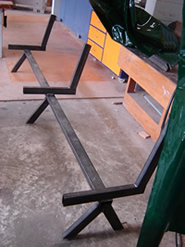
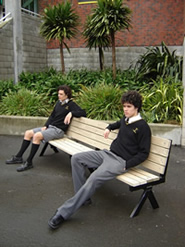
Jo considered using family or friends as clients before deciding on the College itself. He considered problem areas such as seating, the canteen and the car park and discussed them with his client, Deputy Principal Dave Ashby. They decided that the school's outside seating was a very real problem needing to be addressed and Jo took on the design construction of new seating near the Design Technology block as his project.
The key factors in Dave's brief were that the seating be strong, vandal and weather proof, safe, comfortable, long lasting and aesthetically pleasing. The main problem identified by the client was safety, both in terms of students' well-being and of the school's reputation. Cost was discussed and Jo was instructed to keep the cost to a minimum.
Jo identified a range of problems with the existing seats, some of which needed maintenance while a few were broken and beyond repair. There were numerous safety issues with their design. Students tended to play around with the existing seating, climbing and balancing on it as well as sitting! His design had to be robust enough to withstand the horseplay, such as a large number of students piled on to one end of the seat!
The aesthetics and functionality of the current seating meant it was not very welcoming or inviting for people to sit on. Many had slats missing - one had none at all - and students would stick rubbish between them, which not only looked ugly but retained moisture and could smell.
Jo's client was also concerned about vandalism - the destruction of seating or, more likely, graffiti in the form of writing, tagging or scraping. In a boys' school, where there is a lot of rough and tumble, he wanted seating that was strong enough to withstand this and that would be, as far as it was possible, graffiti proof.
Jo started off researching ergonomics. He considered body sizes, weight and height plus movements. With this knowledge he then looked at the weak points of seats. Although designing outside seating he also considered the same factors on inside seating, to further his ideas of what was comfortable, sturdy and safe.
Jo next researched different materials and their qualities, as the selection of material would have a huge impact on cost. The original seating around the Science, Maths and Technology blocks was just a block of wood on bricks. He explored the idea of freestanding aluminium benches with welded aluminium legs and made numerous drawings, but these were ruled out as too costly.Several virtual models were constructed to explore the shape and form of potential solutions using the 3D modelling software ProDESKTOP. These could be rendered in a wide variety of different materials and proved to be very helpful in discussing potential ideas with the client. Throughout this process Jo kept a record of changes made and why.
"The modelling stage helps the client to fully visualise your idea," he says. "The challenge is to choose what media to present your models in that will best reflect your thinking. In my experience no one model is able to do this." When he finished making the models he applied various colours and finishes to the designs.
His final prototype could comfortably seat six students. It was robust to the point of exhaustion, having been tested by the Year 13 students jumping up and down on it.
The main frame was dip-coated black at Fraser Brown of Stratmore Ltd in Lower Hutt, then the slatted wood back attached at school. This was to be coloured yellow (Wellington College colours) but the natural tanalised finish was judged as more appealing and requiring less maintenance.
Jo found the benefit of working with a client was having a real life experience where he had to fulfil a solution to a problem. It was good to get feedback on what was liked about a design and gain experience to deal with the disappointment when something was rejected. He comments "communication is so important. A major drawback was that my client was always busy dealing with student issues, and made regular consultation a difficult process." To compensate, Jo received additional feedback from Assistant Principal John Mills.
Although the project was very time-consuming, Jo says he is happy with the outcome. He has enjoyed Technology since Year 7 and comments that, although students have been really pushed in Year 12-13, he has enjoyed the practical aspect, the creativity and developing process, particularly the environment of working with clients. "I love the interaction with people," he syas.
Jo plans to study at Media Design School, Auckland.
Read an article about Jo from the Dominion Post, June 8 2007