
Steve Andrew and student Matthew Baird
BP621: Industry Mentored Client-based Project
Abstract
Steve Andrew and student Matthew Baird
Reference: Case Study BP621
Classroom Practice: Year 13 Materials Technology
Title: Industry Mentored Client-based Project
Duration: Whole Year
Overview: A small class enabled Steve Andrew at St John's College to implement a programme where each student work with their own choice of client from outside school on an authentic issue with guidance and advice from an appropraite industry mentor set up by the teacher. This programme has formed the basis of his subsequent Year 13 programme with a much greater number of students.
Focus Points:
Background

St John's College, Hamilton, is an integrated boys secondary school with a roll of around 700.
Technology teacher Steve Andrew originally qualified as a motor mechanic and after working in the automotive industry for a number of years moved into teaching in 1989. He started teaching Workshop Technology, and felt comfortable making the transition into Design Technology courses because of the freedom it gave teachers and the ownership it gave to students. With the advent of the new Technology curriculum, Steve focussed on giving all boys at St John's College access to programmes suited to their own particular needs and aspirations. "The new Technology Achievement Standards provide an opportunity for us to hold on to those boys in that middle- to top-ability range who seemed to be lost to the subject after Year 12," he says.
Traditionally the Year 13 Technology class at St John's has been a smaller group of students, most having come via a skills-oriented wood- and metal-based materials programme. Year 9 starts with a half-year compulsory course and moves into an optional full Year 10 programme. The senior technology programme begins at Year 11 with two classes of around 20 students doing similar programmes, "but with room for a bit of individual flexibility." These students feed through to one slightly larger Year 12 Materials Technology class with an additional Unit Standards based course also offered at this level. "By this stage they will be confident working with a selection of materials and bring a good tool box of skills through to Year 13 where there's room in the programme to develop specialist skills where required," Steve says.
Pre-planning

Student Matthew Baird and Director Peter Botting at RML
Steve wanted to develop a Year 13 programme where the class worked on a whole year project in which individual students select their own client-based issue.
Because of the mixed backgrounds of the class, he designed a programme that offered different levels of qualifications:
Since there were only six students in the class, Steve felt confident that he could give the support required for each student to individually select a client-based project that was personally motivating and enabled them to meet their assessment aspirations. He aimed to match each project to a local industry which would provide individual mentoring.
The prospect of approaching a range of industries would normally be daunting, but Steve was fortunate to have access to brokering help from the Waikato Engineering Careers Association (WECA). WECA works with secondary schools, raising awareness of mechanical engineering careers with teachers, career advisors and students. Students are given opportunities to visit the workplaces of WECA members, to understand roles and working environments.

"Developing a Level 3 programme has to be approached very carefully, because there are lots of places where it can all fall over and everyone loses out – the student, the school and the client. Success comes down to the level of planning you put into it."
Two of Steve's students had considerable success and received media attention with their Year 13 Bike Project. It is this type of authentic client issue that he wanted to encourage his Year 13 students to select.
Delivery
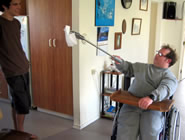
Tony and Matthew testing the tool
The first stage in the delivery of the programme was for students to choose a client and investigate and negotiate an issue.
One student chose to work with a local farmer to look at the issue of feeding calves and the design for a mobile calf feeder. In the research phase he looked at existing products, explored the environment in which calf feeders operate and the amount of feed required to be carried. He identified that calf feeders frequently end up left out in the rain, and that often little money is spent on maintenance. He decided to address the issue of durability which he identified as being a major problem with many existing products.
Another student worked with a client who was looking for a safe and convenient way to fix a tandem to the back of his four-wheel drive vehicle.
As a fall-back for students unable to negotiate a suitable issue with a client of their own choosing, Steve provided a range of options that he had identified through contact with local organisations such as the Hamilton Disability Centre. One such student was Matthew Baird for whom Steve organised a visit to the Centre. "They told me about some of the issues which they had and I thought about a few ideas for a while before settling on a client," he said. His client was Tony, who is immobile from the waist down and in a wheel chair, and for whom Matthew designed and constructed an improved version of a 'grabber' to help him pick things up – see Matthew's Student Showcase.
Once the client and the issue was confirmed for each student, Steve set up initial meetings between the students and potential industry mentors. The students were asked to create an individual profile to promote themselves and their project work and this proved to be a very effective way of achieving an appropriate match between the student and the mentor.
"I wanted the boys to have somebody other than me to sit down and talk to about their project – somebody from outside the school who would understand what they were doing and offer some added advice and guidance."
Steve joined the students in their first meeting with the mentor at which each student presented a folio of work and explained what they had been doing in their technology programme. With only six students in the class these meetings were comfortably fitted in over a three-week period early in the first term.
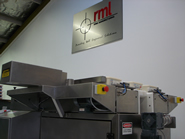
This process proved very successful and a range of mutually beneficial links, such as the The St John's College/RML Automation Link, were firmly established. Students took individual responsibility for managing the ongoing interaction with their client and with their mentor – organising the times of the visits around school, industry and personal commitments – enabling Steve time to step back and monitor the regularity and the effectiveness of the contact.
During the early part of the programme Steve emphasised the step up required in moving from Level 2 to Level 3 and discussed with each student the implications in terms of the requirements for their personal development work.
One of the mentoring companies had regular Monday morning meetings to give production and design staff the opportunity to raise individual issues and discuss specific project related problems in a whole group environment. Steve took up this idea in his programme. "Once a week all the boys brought their folders in and gave everyone a quick rundown on where they were at and identified problems that had cropped up. Later things started to get too busy so we stopped having them, but I can see how important they are."
After the first meeting with the client and the successful negotiation of the initial brief all students tended to follow a similar development path. Key factor research led into a secondary follow-up interview enabling the brief to be further clarified and more detailed specifications established. A range of concepts were developed with the final concept selection justified in terms of a concept comparison matrix. A mock-up development and evaluation phase enabled a final design to be established and materials research and selection to be carried out. Design drawings were produced and the prototype constructed. An initial evaluation was carried out and required modifications made before the final evaluation of the product was completed and documented.
With students managing their own client and mentor interaction, projects tended to progress at widely different rates with some students getting well ahead of others in their practice. This limited the amount of whole-of-class work that Steve was able to structure into the programme.
However as the end of the year approached and the individual projects reached their conclusion, the overall success of the programme was confirmed. With the project work completed, Steve invited the mentors from industry and the contacts at WECA into the school for a celebratory afternoon tea. Each student presented the outcome they had developed and talked about the value of their link with the industry mentor.
"It was a really valuable feedback session and provided closure for me for that year. It gave the students an opportunity to show how much they had gained from the out-of-school interaction and a chance to say 'Thank you very much'."
At that meeting Steve expressed his concern with the amount of time which the contact necessitated from the industry side but was surprised and delighted to find that this wasn't seen by the group to be a significant issue and that they were only to pleased to continue the partnership.
Outcomes
Matthew Baird:
"Working with people who will tell you straight up that what you've developed was useless was a bit of a shock at first – I haven't had that sort of honest response in some of my past projects. My client Tony just told me straight up what he thought, which was quite refreshing really."
Tony, Matthew's client:
"What has really impressed me is that every time that I phoned Matt he said 'Right, I'll come over'. He's actually taken the time to sit down with me and go through it and sort it out. I think that's why its been so successful – because we've worked together, and that's been so marvellous."
The ability of students to interact effectively with their clients, industry mentors and other stakeholders became more evident as the development work progressed. By the end of the project it was obvious that the high level of constructive feedback into the ongoing development process had significantly influenced the fitness for purpose of the final products.
Students also willingly gave constructive feedback to each other throughout the year, a factor that improved the quality of the development process and the students' outcomes.
"The final design of the calf feeder ended up like a big mobile trough on wheels," says Steve. "The student had worked on the efficiency of the towing connection and other features such as galvanising that improved the durability. He had a tight budget and worked closely with the farmer to produce a practical solution to what was a real client issue."

Matthew's grabbing tool
"With the bike rack, the client specifications were quite demanding. The fixture had to be removable and the back door of the vehicle had to be able to open with the bike still on. So there were some tricky problems to be solved and quite a few regulatory requirements to satisfy."
"In Matthew's case this was a real-life situation. He had to provide his client with a device that would work well and last for a long time, so it had to be made properly. Matthew didn't have the facilities or the level of skill required and if he'd decided to do all the machining and construction work himself it most likely would never have been fit for purpose. However after doing the design and development work, his mentor, Peter Botting at RML, arranged for the calf feeder parts to be accurately laser cut and machined to ensure a quality final product."
In their extended contact with the individual industry mentors, students not only received valuable technical advice but the opportunity to see current leading edge industrial manufacturing practice in the region.
"It was interesting to see that RML never make anything unless it's first working on the computer," says Matthew Baird. "They'll never make anything unless they know that it will work."

"The importance of day-to-day planning was brought home to Matthew," says Peter Botting. "At RML up to 15 significant equipment items are being manufactured in any one week – each with 30-odd tasks in the area of design, assembly, manufacture and installation. We were able to show him how we use Microsoft Project to effectively budget the number of hours for each."
All students commented on the improvement in their research skills and problem solving ability over the course of their senior technology programme. Working with companies like RML enhanced their appreciation of the value of the 'technology process' "Seeing how industry goes about the process and how closely it stacks up with what we have been doing at school has reinforced the value of the classroom learning we've had," says Matthew.
Throughout the year Steve emphasised the importance of presentation, and was particularly impressed with the detail in their documentation of the development work and the overall quality of the presentation of the final folios. This has helped Steve to extend the pool of exemplar projects for future students - to give them ideas on the type of project they can select and how to effectively document and present their work.
What next?

Tony and Matthew testing the tool
Despite the fact that his 2007 Year 13 class was much larger, with more than 20 students, Steve again offered free choice of authentic clients and suitable issues. However, a larger class meant he had to change the way he had been using the links with his industry mentors. The 2007 mentors would come into school to talk with groups of students on broad issues such as client contact, writing an initial brief and material selection. This has the added benefit of enabling Steve to extend the interaction to involve students in his Years 11 and 12 Technology classes.
"I knew the range of skills covered by our group of mentors, so I could ask a person to come along and talk about a particular thing," says Steve. "The mentors have all been more than willing to work that way. When I've had students with specific problems, I've just phoned a mentor and asked if they could help and they just say 'Bring him down'."
The larger class made it difficult for Steve to attend all of the initial meetings between the students and their clients, so he decided to focus on the students who would benefit most from his participation in the meeting. The larger class also encouraged him to consolidate the level of teacher input in the early stages of the year to ensure that every student had a firm base to build from, particularly in terms of their planning and their understanding of the step-up required in Year 13.
He also planned to implement a process which he had trialled with his Year 12 class in which students were encouraged to identify three potential issues and then go through a screening process to evaluate each and justify their final selection in terms of access to stakeholders, authenticity of the issue and the personal enjoyment factor.
Steve produced a draft booklet for his 2007 students based on material that two local firms use for their client interviews to establish their initial briefs. "It certainly helped students make initial contact with their client and get the correct information. It's also a good planning tool and I'll be developing it further for next year."
Steve has also looked to extend the opportunities for visits to places of interest and relevance to his students. The Air New Zealand Training School and Maintenance Section in Auckland is a convenient day-trip from Hamilton, and, with almost half of his class studying both Physics and Technology, Steve worked with the Science department to organise a joint class trip so students could see the range of work undertaken there.
"We need to work closer with other subjects within the school. We also have a strong link with our careers department, which actively supports our subject with funding for careers visits, etc. They get the spin-off from exposure to the links in industry that I have developed."